EdgeVertexOperator
- class EdgeVertexOperator(coeffs, left_indices, right_indices, boundaries)
Bases:
objectAn edge-vertex operator.
Definition
This operator is defined in terms of the edge-vertex (\(E_{jk}\), \(V_j\)) operators:
\[\begin{align} V_j &= -i \gamma_{2j-1} \gamma_{2j} = -(a_j a_j - a_j a^\dagger_j + a^\dagger_j a_j - a^\dagger_j a^\dagger_j) = 1 - 2 a^\dagger_j a_j \, , \nonumber \\ E_{jk} &= -i \gamma_{2j-1} \gamma_{2k-1} = -i (a_j a_k + a_j a^\dagger_k + a^\dagger_j a_k + a^\dagger_j a^\dagger_k) = -E_{kj} \nonumber \end{align}\]which fulfill the following mixed fermionic-bosonic commutation relations for \(j \neq k \neq l \neq m\): [1]
\[\begin{align} \left\{ E_{jk}, V_k \right\} &= 0 \nonumber \\ \left\{ E_{jk}, E_{kl} \right\} &= 0 \nonumber \\ \left[ V_k, V_l \right] &= 0 \nonumber \\ \left[ E_{jk}, V_l \right] &= 0 \nonumber \\ \left[ E_{jk}, E_{lm} \right] &= 0 \nonumber \, . \end{align}\]In summary, edge and vertex operators commute, unless they share exactly one index, in which case they anticommute.
Note
The relations above are stated for \(j \neq k \neq l \neq m\), so they do not cover two edge operators spanning the same pair of modes. Those commute: since \(E_{kj} = -E_{jk}\), such a pair is collinear, and every operator commutes with itself. This is why the condition is “exactly one” shared index rather than “at least one”.
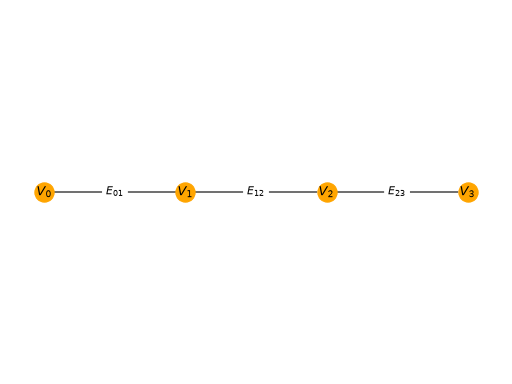
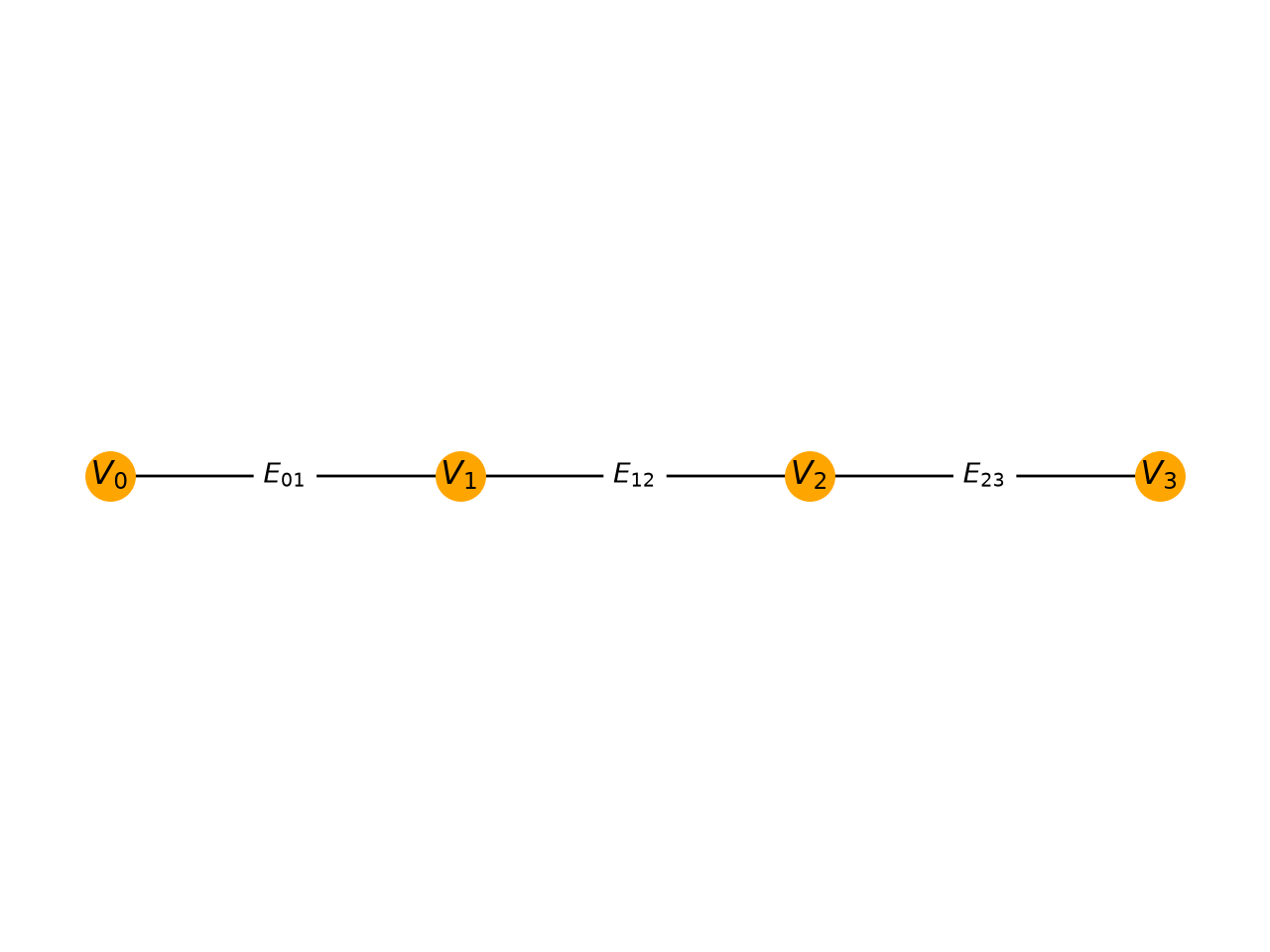
A simple example can be represented visually like so:
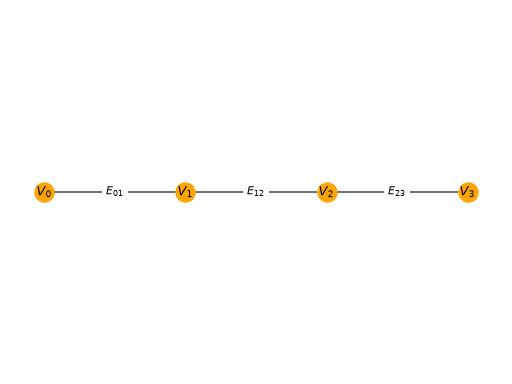
We can abuse the notation a little bit and define \(V_j = E_{jj}\) which reflects how the internal data structure of this operator works. This makes the definition of the entire operator the following:
\[\text{\texttt{EdgeVertexOperator}} = \sum_i c_i \bigotimes_{lr} E_{lr} \, ,\]where \(lr\) indexing the involved operator terms and \(c_i\) is the (complex) coefficient making up the linear combination of products. The indices \(l\) and \(r\) can take any value between 0 and the number of fermionic modes acted upon by the operator minus 1.
We will refer to \(E_{lr}\) as generalized edge operators.
Implementation
This class stores the terms and coefficients in multiple sparse vectors, akin to the compressed sparse row format commonly used for sparse matrices. More concretely, a single operator contains 4 arrays:
coeffsA vector of complex coefficients consisting of two 64-bit floating point numbers.
left_indicesA vector of 32-bit integers storing the left fermionic mode indices (\(l\) above).
right_indicesA vector of 32-bit integers storing the right fermionic mode indices (\(r\) above).
boundariesA vector of integers indicating the boundaries in
actionsandmodes.Fermionic modes indexed by
left_indicesandright_indicesare considered spinless.Note
You may access read-only copies of these internal arrays via their respective methods:
get_coeffs(),get_left_indices(),get_right_indices(), andget_boundaries().This data structure allows for very efficient construction and manipulation of operators. However, it implies that duplicate terms may be contained in an operator at any moment. These must be resolved manually through the use of
simplify().Construction
An operator can be constructed directly by providing the arrays outlined above:
>>> from qiskit_fermions.operators import EdgeVertexOperator
>>> coeffs = [1.0, 2.0, -3.0, 4.0j, -0.5j]
>>> left_indices = [0, 3, 0, 2, 3, 0]
>>> right_indices = [1, 4, 1, 2, 3, 1]
>>> boundaries = [0, 0, 1, 2, 4, 6]
>>> op = EdgeVertexOperator(coeffs, left_indices, right_indices, boundaries)
>>> print(format(op))
  1.000000e0 +0.000000e0j * ()
  2.000000e0 +0.000000e0j * (E(0,1))
  0.000000e0 +4.000000e0j * (E(0,1) V(2))
 -0.000000e0-5.000000e-1j * (V(3) E(0,1))
 -3.000000e0 +0.000000e0j * (E(3,4))
For convenience, it is possible to construct an operator from a Python dictionary like so:
>>> op = EdgeVertexOperator.from_dict(
...     {
...         (): 1.0,
...         ((0, 1),): 2.0,
...         ((3, 4),): -3.0,
...         ((0, 1), (2, 2)): 4.0j,
...         ((3, 3), (0, 1)): -0.5j,
...     }
... )
>>> print(format(op))
  1.000000e0 +0.000000e0j * ()
  2.000000e0 +0.000000e0j * (E(0,1))
  0.000000e0 +4.000000e0j * (E(0,1) V(2))
 -0.000000e0-5.000000e-1j * (V(3) E(0,1))
 -3.000000e0 +0.000000e0j * (E(3,4))
In addition, the following construction and quick helper methods are available:
zero()Constructs the additive identity operator.
one()Constructs the multiplicative identity operator.
from_terms(terms)Constructs a new operator from an iterator of terms (see also
iter_terms()).from_terms_with_groups(terms)Constructs a new operator from an iterator of terms with groups (see also
iter_terms_with_groups()).Formatting
In the examples above, the constructed operators have been printed using the output from
format(), which results in a human-readable form of the operator.>>> print(format(op)) 1.000000e0 +0.000000e0j * () 2.000000e0 +0.000000e0j * (E(0,1)) 0.000000e0 +4.000000e0j * (E(0,1) V(2)) -0.000000e0-5.000000e-1j * (V(3) E(0,1)) -3.000000e0 +0.000000e0j * (E(3,4))
Note
The printing order of
format(op)gets explicitly sorted before printing. As such, it does not reflect the order of the terms inside the operator.An alternative form can be obtained from the
repr()function, which results in a Python-interpretable representation. In other words, this output can readily be copied and pasted into a Python shell:>>> print(repr(op)) EdgeVertexOperator.from_dict({...})
Finally, for large operators both of these outputs may be very long and undesirable. Then, a very simple form with minimal information can be obtained from the
str()function:>>> print(str(op)) <EdgeVertexOperator with 5 terms>
Iteration
Since the underlying data structure is implemented in Rust and has a non-trivial layout, it cannot be iterated over directly:
>>> list(iter(op))
Traceback (most recent call last):
  ...
TypeError: 'qiskit_fermions.operators.edge_vertex_operator.EdgeVertexOperator' object is not iterable
Instead, this class provides custom iterators to fulfill this purpose:
>>> list(sorted(op.iter_terms()))
[([], (1+0j)), ([(0, 1)], (2+0j)), ([(0, 1), (2, 2)], 4j), ([(3, 3), (0, 1)], (-0-0.5j)), ([(3, 4)], (-3+0j))]
See also
iter_terms()For more relevant implementation details.
The table below lists all available iterators:
An iterator over the operator's terms.
An iterator over the operator's terms with their associated group index.
Arithmetics
The following arithmetic operations are supported:
Addition/Subtraction
>>> op = EdgeVertexOperator.one()
>>> (op + op).simplify()
EdgeVertexOperator.from_dict({(): 2+0j})
>>> (op - op).simplify()
EdgeVertexOperator.from_dict({})
>>> op += op
>>> op.simplify()
EdgeVertexOperator.from_dict({(): 2+0j})
>>> op -= op
>>> op.simplify()
EdgeVertexOperator.from_dict({})
Scalar Multiplication/Divison
>>> op = EdgeVertexOperator.one()
>>> (2 * op).simplify()
EdgeVertexOperator.from_dict({(): 2+0j})
>>> (op / 2).simplify()
EdgeVertexOperator.from_dict({(): 0.5+0j})
>>> op *= 2
>>> op.simplify()
EdgeVertexOperator.from_dict({(): 2+0j})
>>> op /= 2
>>> op.simplify()
EdgeVertexOperator.from_dict({(): 1+0j})
Operator Composition
Note
Operator composition corresponds to left-multiplication:
c = a & bcorresponds to \(C = B A\). In other words, the composition of two operators returns a resulting operator that performs “firstaand thenb”.>>> op1 = EdgeVertexOperator.from_dict({(): 2.0, ((0, 1),): 3.0}) >>> op2 = EdgeVertexOperator.from_dict({(): 1.5, ((2, 2),): 4.0}) >>> comp = (op1 & op2).simplify() >>> print(format(comp)) 3.000000e0 +0.000000e0j * () 4.500000e0 +0.000000e0j * (E(0,1)) 8.000000e0 +0.000000e0j * (V(2)) 1.200000e1 +0.000000e0j * (V(2) E(0,1)) >>> op2 &= op1 >>> print(format(op2.simplify())) 3.000000e0 +0.000000e0j * () 4.500000e0 +0.000000e0j * (E(0,1)) 1.200000e1 +0.000000e0j * (E(0,1) V(2)) 8.000000e0 +0.000000e0j * (V(2)) >>> squared = (op1 ** 2).simplify() >>> print(format(squared)) 4.000000e0 +0.000000e0j * () 1.200000e1 +0.000000e0j * (E(0,1)) 9.000000e0 +0.000000e0j * (E(0,1) E(0,1))
Note
For convenience, the right-multiplication is implemented by
c = a @ b(resulting in \(C = A B\)).>>> (op1 @ op2).equiv(op2 & op1) True
Other Operations
In addition to the magic methods that correspond to the arithmetic operations outlined above, the following methods are available:
adjoint()Returns the Hermitian conjugate (or adjoint) of this operator.
ichop([atol])Removes terms whose coefficient magnitude lies below the provided threshold.
simplify([atol])Returns an equivalent but simplified operator.
normal_ordered([ascending, reduce])Returns an equivalent operator with normal ordered terms.
relabel_modes(permutation)Returns a new operator with relabeled modes.
Properties
Finally, various methods exist to check certain properties of an operator:
is_hermitian([atol])Returns whether this operator is Hermitian.
Attributes
- groups
An optional vector of group indices for each term.
For more information refer to the
groupingmodule.
Methods
- adjoint()
Returns the Hermitian conjugate (or adjoint) of this operator.
Two things happen to every term:
the coefficients are complex conjugated
the generators within each term are reversed in order
The reversal is required because \((AB)^\dagger = B^\dagger A^\dagger\). While the individual vertex and edge generators are Hermitian, they anticommute when they share an index (see the definition above), so the reversed product is not equal to the original one and the order cannot simply be dropped.
Note that this does not make the operator self-adjoint in general: an operator with complex coefficients differs from its adjoint (as the doctest below illustrates).
>>> from qiskit_fermions.operators import EdgeVertexOperator
>>> op = EdgeVertexOperator.from_dict({(): -1.0j, ((0, 0), (0, 1)): 1.0})
>>> adj = op.adjoint()
>>> print(format(adj))
 -0.000000e0 +1.000000e0j * ()
  1.000000e0 -0.000000e0j * (E(0,1) V(0))
- equiv(other, atol=1e-08)
Checks this operator for equivalence with another operator.
Equivalence in this context means approximate equality up to the specified absolute tolerance. To be more precise, this method returns
True, when all the absolute values of the coefficients in the differenceother - selfare below the specified thresholdatol.Note
This is the mathematical comparison you almost always want. It differs from the
==operator, which tests exact equality of the stored terms (their coefficients, indices, and internal term boundaries) with no tolerance and no simplification. Two mathematically equal operators can therefore compare unequal under==if they are stored differently – for example an unsimplifieda + aversus2 * a, or terms held in a different order. Useequivto compare operators up to numerical tolerance.>>> from qiskit_fermions.operators import EdgeVertexOperator >>> op = EdgeVertexOperator.from_dict({(): 1e-7}) >>> zero = EdgeVertexOperator.zero() >>> op.equiv(zero) False >>> op.equiv(zero, 1e-6) True >>> op.equiv(zero, 1e-9) False
- Parameters:
other – the other operator to compare with.
atol – the absolute tolerance for the comparison. This value defaults to
1e-8.
- classmethod from_dict(data)
Constructs a new operator from a dictionary.
>>> from qiskit_fermions.operators import EdgeVertexOperator
>>> op = EdgeVertexOperator.from_dict(
...     {
...         (): 1.0-1.0j,
...         ((0, 0),): 2.0,
...         ((0, 1),): 2.0j,
...     }
... )
>>> print(format(op))
  1.000000e0 -1.000000e0j * ()
  2.000000e0 +0.000000e0j * (V(0))
  0.000000e0 +2.000000e0j * (E(0,1))
- Parameters:
data – a dictionary mapping tuples of terms to complex coefficients. Each key is a tuple of
(int, int)pairs indicating the indices of the generalized edge operator, \(E_{lr}\) (if \(l = r\) then this corresponds to the vertex operator \(V_l\)).- Returns:
A new operator.
- classmethod from_terms(terms)
Constructs a new operator from an iterator of terms (see also
iter_terms()).>>> from qiskit_fermions.operators import EdgeVertexOperator >>> op = EdgeVertexOperator.from_dict({(): 2.0, ((0, 0),): 1.0, ((0, 1),): -1.0j}) >>> op.equiv(EdgeVertexOperator.from_terms(op.iter_terms())) True
- Parameters:
terms – an iterator of terms as produced by
iter_terms().- Returns:
A new operator.
- classmethod from_terms_with_groups(terms)
Constructs a new operator from an iterator of terms with groups (see also
iter_terms_with_groups()).>>> from qiskit_fermions.operators import EdgeVertexOperator >>> op = EdgeVertexOperator([2.0, 1.0, -1.0j], [0, 0], [0, 1], [0, 0, 1, 2]) >>> op.groups = [0, 1, 1] >>> reconstructed = EdgeVertexOperator.from_terms_with_groups(op.iter_terms_with_groups()) >>> op.equiv(reconstructed) and op.groups == reconstructed.groups True
- Parameters:
terms – an iterator of terms as produced by
iter_terms_with_groups().- Returns:
A new operator.
- get_boundaries()
Returns a read-only list of the indices indicating the boundaries between operator terms.
Note
This method returns a copy of the internal data.
See also
The explanation of the internal data structure, here.
>>> from qiskit_fermions.operators import EdgeVertexOperator
>>> op = EdgeVertexOperator.one()
>>> op += EdgeVertexOperator.from_dict({((0, 1),): 1.0})
>>> op.get_boundaries()
[0, 0, 1]
- Returns:
A list of the operator’s terms boundaries.
- get_coeffs()
Returns a read-only list of the operator’s coefficients.
Note
This method returns a copy of the internal data.
See also
The explanation of the internal data structure, here.
>>> from qiskit_fermions.operators import EdgeVertexOperator
>>> op = EdgeVertexOperator.one()
>>> op += -1j * EdgeVertexOperator.one()
>>> op.get_coeffs()
[(1+0j), -1j]
- Returns:
A list of the operator’s coefficients.
- get_left_indices()
Returns a read-only list of the left indices of all generalized edge operator terms.
Note
This method returns a copy of the internal data.
See also
The explanation of the internal data structure, here.
>>> from qiskit_fermions.operators import EdgeVertexOperator
>>> op = EdgeVertexOperator.from_dict({((0, 0),): 1.0})
>>> op += EdgeVertexOperator.from_dict({((0, 1),): 1.0})
>>> op.get_left_indices()
[0, 0]
- Returns:
A list of the left indices of all generalized edge operator terms.
- get_right_indices()
Returns a read-only list of the right indices of all generalized edge operator terms.
Note
This method returns a copy of the internal data.
See also
The explanation of the internal data structure, here.
>>> from qiskit_fermions.operators import EdgeVertexOperator
>>> op = EdgeVertexOperator.from_dict({((0, 0),): 1.0})
>>> op += EdgeVertexOperator.from_dict({((0, 1),): 1.0})
>>> op.get_right_indices()
[0, 1]
- Returns:
A list of the right indices of all generalized edge operator terms.
- get_support()
Returns the set of mode indices which this operator acts upon.
>>> from qiskit_fermions.operators import EdgeVertexOperator
>>> op = EdgeVertexOperator.from_dict(
...     {
...         ((0, 1), (3, 4)): 1,
...         ((7, 7),): 1,
...     }
... )
>>> assert op.get_support() == {0, 1, 3, 4, 7}
- Returns:
The set of mode indices which this operator acts upon.
- group_weights()
Returns the mean absolute coefficient magnitude of each group.
The
i-th entry is the sum ofabs(coeff)over the terms in groupi, divided by the number of terms in that group. IfgroupsisNone, this function also returnsNone.This is the sampling weight of a randomized product formula (e.g. qDRIFT) that draws whole groups rather than individual terms. Computing it natively is considerably cheaper than reducing
get_coeffs()andgroupsin NumPy, because those two accessors each copy one value per ungrouped term out of the operator only for it to be aggregated back down to one value per group, whereas this returns just thenum_groups()reduced values.Note
A group index that no term carries weighs
0.0, which keeps it out of the sample.>>> from qiskit_fermions.operators import EdgeVertexOperator >>> op = EdgeVertexOperator( ... [1.0, 2.0, -1.0], ... [0, 1, 2, 3], ... [1, 0, 3, 2], ... [0, 1, 3, 4], ... ) >>> print(op.group_weights()) None >>> op.groups = [0, 1, 0] >>> op.group_weights() [1.0, 2.0]
- Returns:
The mean absolute coefficient magnitude of each group index.
- has_groups()
Returns whether this operator tracks group indices.
This is equivalent to (but cheaper than) checking
op.groups is not None, because it does not copy the group indices out of the operator in order to inspect them.Note
This returns
Trueeven whengroupsis an empty list, which is the state of a grouped operator that holds no terms.>>> from qiskit_fermions.operators import EdgeVertexOperator >>> op = EdgeVertexOperator( ... [1.0, 2.0, -1.0], ... [0, 1, 2, 3], ... [1, 0, 3, 2], ... [0, 1, 3, 4], ... ) >>> op.has_groups() False >>> op.groups = [0, 1, 0] >>> op.has_groups() True
- Returns:
Whether
groupsis set on this operator.
- ichop(atol=1e-08)
Removes terms whose coefficient magnitude lies below the provided threshold.
This method modifies the operator in place and returns
None.Caution
This method truncates coefficients greedily! If the acted upon operator may contain separate coefficients for duplicate terms consider calling
simplify()instead!>>> from qiskit_fermions.operators import EdgeVertexOperator >>> op = EdgeVertexOperator.from_dict({(): 1e-4, ((1, 0),): 1e-6, ((0, 1),): 1e-10}) >>> print(format(op)) 1.000000e-4 +0.000000e0j * () 1.000000e-10 +0.000000e0j * (E(0,1)) 1.000000e-6 +0.000000e0j * (E(1,0)) >>> op.ichop() >>> print(format(op)) 1.000000e-4 +0.000000e0j * () 1.000000e-6 +0.000000e0j * (E(1,0)) >>> op.ichop(1e-5) >>> print(format(op)) 1.000000e-4 +0.000000e0j * ()
- Parameters:
atol – the absolute tolerance for the cutoff. This value defaults to
1e-8.
- is_hermitian(atol=1e-08)
Returns whether this operator is Hermitian.
Note
This check is implemented using
equiv()on the fully reducednormal_ordered()difference ofselfand itsadjoint()andzero(). Because that normal form contracts every reducible pair of adjacent generators — including fusing two edge operators that share a single mode via \(E_{ab} E_{bc} = -i E_{ac}\) — a term that only cancels against its adjoint after such a contraction is still recognized as zero.- Parameters:
atol – The numerical accuracy upto which coefficients are considered equal. This value defaults to
1e-8.- Returns:
Whether this operator is Hermitian.
- iter_terms()
An iterator over the operator’s terms.
Warning
Mutating the iteration items does not affect the underlying operator data.
>>> from qiskit_fermions.operators import EdgeVertexOperator
>>> op = EdgeVertexOperator.from_dict({(): 2.0, ((0, 0),): 1.0, ((0, 1),): -1.0j})
>>> list(sorted(op.iter_terms()))
[([], (2+0j)), ([(0, 0)], (1+0j)), ([(0, 1)], (-0-1j))]
- iter_terms_with_groups()
An iterator over the operator’s terms with their associated group index.
Warning
Mutating the iteration items does not affect the underlying operator data.
>>> from qiskit_fermions.operators import EdgeVertexOperator
>>> op = EdgeVertexOperator([2.0, 1.0, -1.0j], [0, 0], [0, 1], [0, 0, 1, 2])
>>> op.groups = [0, 1, 1]
>>> list(op.iter_terms_with_groups())
[([], (2+0j), 0), ([(0, 0)], (1+0j), 1), ([(0, 1)], (-0-1j), 1)]
- normal_ordered(ascending=True, reduce=True)
Returns an equivalent operator with normal ordered terms.
The normal order of an operator term is defined such that all vertex operators appear before all edge operators. Within each group, the acted-upon modes are ordered lexicographically.
Note
When a term is being reordered, the mixed commutation and anti-commutation relations have to be taken into account. See here for the detailed definitions.
>>> from qiskit_fermions.operators import EdgeVertexOperator
>>> op = EdgeVertexOperator.from_dict({((0, 1), (1, 0), (1, 2), (0, 0), (2, 2)): 1})
>>> print(format(op.normal_ordered(reduce=False).simplify()))
 -1.000000e0 -0.000000e0j * (V(0) V(2) E(0,1) E(1,0) E(1,2))
>>> print(format(op.normal_ordered().simplify()))
  1.000000e0 +0.000000e0j * (V(0) V(2) E(1,2))
- Parameters:
ascending – the orientation convention for edge operators. Since \(E_{kj} = -E_{jk}\), every edge operator has two representations;
Trueselects \(j < k\) andFalseselects \(j > k\), absorbing the sign into the coefficient. Vertex operators are unaffected. This value defaults toTrue.reduce – whether to contract adjacent generators that combine into a scalar or into a single generator. See the example above. This value defaults to
True.
- Returns:
An equivalent but normal-ordered operator.
- num_groups()
Returns the number of groups.
If
groupsisNone, this function also returnsNone. Otherwise, it will return the number of groups which is defined to be the largest occurring group index plus 1 (which may therefore be used as the index for the next group).>>> from qiskit_fermions.operators import EdgeVertexOperator >>> op = EdgeVertexOperator( ... [1.0, 2.0, -1.0], ... [0, 1, 2, 3], ... [1, 0, 3, 2], ... [0, 1, 3, 4], ... ) >>> op.groups = [0, 1, 0] >>> op.num_groups() 2
- Returns:
The largest group index in
groupsplus 1.
- classmethod one()
Constructs the multiplicative identity operator.
Composing the operator that is constructed by this method with another one has no effect.
>>> from qiskit_fermions.operators import EdgeVertexOperator
>>> op = EdgeVertexOperator.from_dict({(): 2.0})
>>> one = EdgeVertexOperator.one()
>>> op & one == op
True
- relabel_modes(permutation)
Returns a new operator with relabeled modes.
>>> from qiskit_fermions.operators import EdgeVertexOperator
>>> op = EdgeVertexOperator.from_dict({
...     ((0, 1), (2, 3)): 1,
...     ((1, 2), (3, 0)): 1,
... })
>>> permutation = [4, 2, 5, 3]
>>> relabeled = op.relabel_modes(permutation)
>>> print(format(relabeled))
  1.000000e0 +0.000000e0j * (E(2,5) E(3,4))
  1.000000e0 +0.000000e0j * (E(4,2) E(5,3))
- Parameters:
permutation – the index permutation list. Mode
iis relabeled topermutation[i], so the list must contain no duplicate entries and must be long enough to index every mode the operator acts upon (its length must exceed the operator’s largest mode index).- Returns:
A new operator with its modes relabeled.
- Raises:
ValueError – if
permutationcontains duplicate entries, or is too short to relabel some mode the operator acts upon.
- simplify(atol=1e-08)
Returns an equivalent but simplified operator.
The simplification process first sums all coefficients that belong to equal terms and then only retains those whose total coefficient exceeds the specified tolerance (just like
ichop()).When an operator has been arithmetically manipulated or constructed in a way that does not guarantee unique terms, this method should be called before applying any method that filters numerically small coefficients to avoid loss of information. See the example below which showcases how
ichop()can truncate terms that sum to a total coefficient magnitude which should not be truncated:>>> from qiskit_fermions.operators import EdgeVertexOperator >>> coeffs = [1e-5] * int(1e5) >>> boundaries = [0] + [0] * int(1e5) >>> op = EdgeVertexOperator(coeffs, [], [], boundaries) >>> canon = op.simplify(1e-4) >>> assert canon.equiv(op.one(), 1e-6) >>> op.ichop(1e-4) >>> assert op.equiv(op.zero(), 1e-6)
- Parameters:
atol – the absolute tolerance for the cutoff. This value defaults to
1e-8.- Returns:
An equivalent but simplified operator.
- split_out_groups(group_indices=None)
Splits this operator into an optional list of new operators based on
groups.If
groupsisNone, this function also returnsNone. Otherwise, ifgroup_indicesisNone(the default), it returns a list of one new operator for every group index ingroups, in index order. Ifgroup_indicesis given, only the requested indices are built, in the given order: this avoids the cost of constructing operators for groups that are never used, which is especially beneficial when only a small number of groups out of a much larger total are needed, e.g. when subsampling groups for a randomized product formula. A duplicate index ingroup_indicesis returned once per occurrence.>>> from qiskit_fermions.operators import EdgeVertexOperator >>> op = EdgeVertexOperator( ... [1.0, 2.0, -1.0], ... [0, 1, 2, 3], ... [1, 0, 3, 2], ... [0, 1, 3, 4], ... ) >>> print(op.split_out_groups()) None >>> op.groups = [0, 1, 0] >>> groups = op.split_out_groups() >>> for g in groups: ... print(list(sorted(g.iter_terms()))) [([(0, 1)], (1+0j)), ([(3, 2)], (-1+0j))] [([(1, 0), (2, 3)], (2+0j))] >>> groups = op.split_out_groups(group_indices=[1]) >>> for g in groups: ... print(list(sorted(g.iter_terms()))) [([(1, 0), (2, 3)], (2+0j))]
- Parameters:
group_indices – the group indices for which to build operators, in the desired output order. When omitted, every group is built, in index order.
- Returns:
An optional vector of one new operator for each requested group index.
- classmethod zero()
Constructs the additive identity operator.
Adding the operator that is constructed by this method to another one has no effect.
>>> from qiskit_fermions.operators import EdgeVertexOperator
>>> op = EdgeVertexOperator.from_dict({(): 2.0})
>>> zero = EdgeVertexOperator.zero()
>>> op + zero == op
True
Protocol Methods
- static _anti_commutator_(op_a, op_b)
- static _commutator_(op_a, op_b)
- static _double_commutator_(op_a, op_b, op_c, sign)
- _fermion_operator_()
Converts this operator into a
FermionOperator.This implements the
SupportsFermionOperatorprotocol by delegating toedge_vertex_to_fermion().
- _majorana_operator_()
Converts this operator into a
MajoranaOperator.This implements the
SupportsMajoranaOperatorprotocol by delegating toedge_vertex_to_majorana().