Group operator terms: exploit the operator structure
Grouping is one of the operations under qiskit_fermions.operators.terms,
which collects routines that partition the terms of an operator based on their
structure.
As described in the operators guide, operators can store a groups array - an optional part of the sparse data structure that associates each term with a group index. Terms sharing the same group index form a group, enabling systematic exploitation of structure in downstream processing.
By grouping related terms (whether by physical properties, algebraic relationships, or problem-specific symmetries), you can unlock several benefits:
Optimized circuit synthesis: Grouped terms carry problem-specific information through the stack, enabling simpler optimization of the synthesized circuits, resulting in reduced circuit depth and gate count.
Physical structure preservation: Groups encode meaningful structure from the original problem (for example, interaction patterns or symmetries), that can be exploited for more physically meaningful decompositions.
Flow set selection: Grouping can naturally encode flow sets and other graph-theoretic structures relevant to quantum simulation, as shown in [1].
Improved algorithmic stability: As demonstrated in the SqDRIFT routine, some algorithms can benefit from improved stability or performance due to the preservation of physical properties.
Usage
The simplest way to define an operator grouping is by setting the target
operator’s groups attribute. Below is an example for grouping terms
according to the line flow sets as shown in Figure 1c of [1].
Hint
The qiskit_fermions.operators.terms.grouping module provides convenience
methods for automatically identifying structure in an operator and assigning
group indices accordingly.
>>> import rustworkx as rx
>>> graph = rx.PyDiGraph()
>>> _ = graph.add_nodes_from(range(6))
>>> edges = [(0, 1), (1, 2), (3, 0), (1, 4), (5, 2), (5, 4), (4, 3)]
>>> groups = [0, 0, 1, 2, 1, 3, 3]
>>> edges_with_group_as_payload = [(i, j, g) for (i, j), g in zip(edges, groups)]
>>> _ = graph.add_edges_from(edges_with_group_as_payload)
>>> from rustworkx.visualization import mpl_draw
>>> mpl_draw(
...     graph,
...     pos={i: (i % 3, i // 3) for i in range(6)},
...     edge_labels=str,
...     with_labels=True,
... )
<Figure size ... with 1 Axes>
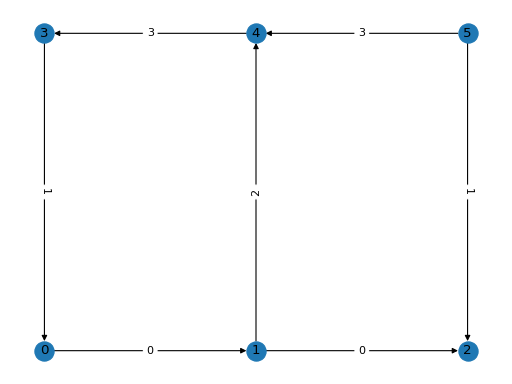
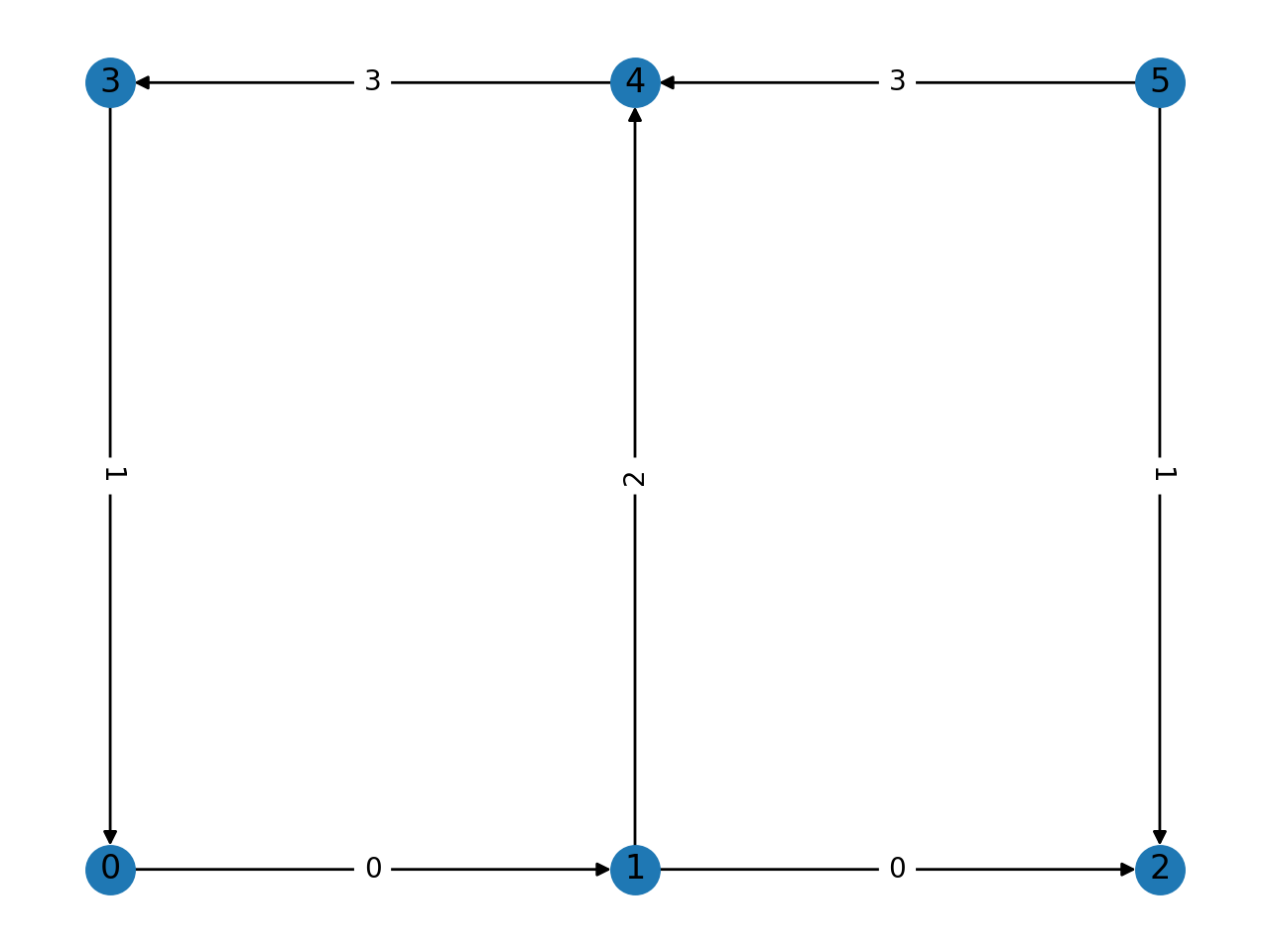
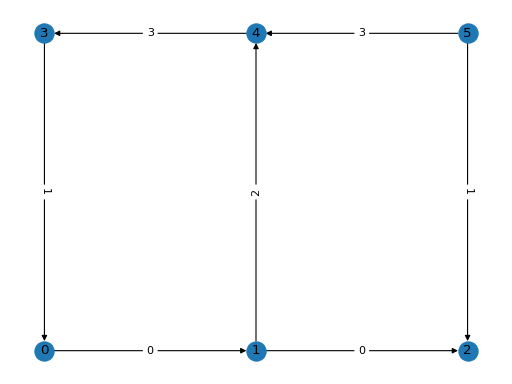
Here, we have a simple two by three lattice of Majorana modes connected by directed edges. Each edge represents a term in our operator acting on the two connected modes. We want to group these terms according to their edge labels (shown on the graph): terms connected by edges with the same label are placed in the same group. The following code shows how that can be done:
>>> from qiskit_fermions.operators import MajoranaOperator
>>>
>>> # Construct operator directly using sparse arrays
>>> # 7 terms, each with coefficient 1.0, modes from edge endpoints
>>> op = MajoranaOperator(
...     coeffs=[1.0] * 7,
...     modes=[node for edge in edges for node in edge],
...     boundaries=[0, 2, 4, 6, 8, 10, 12, 14],
... )
>>>
>>> # Assign group indices to terms (groups is part of the sparse data structure)
>>> op.groups = groups
>>>
>>> # Partition operator by groups
>>> grouped_ops = op.split_out_groups()
>>>
>>> # Inspect each group
>>> for i, g in enumerate(grouped_ops):
...     print(f"Group {i}: {list(sorted(g.iter_terms()))}")
Group 0: [([0, 1], (1+0j)), ([1, 2], (1+0j))]
Group 1: [([3, 0], (1+0j)), ([5, 2], (1+0j))]
Group 2: [([1, 4], (1+0j))]
Group 3: [([4, 3], (1+0j)), ([5, 4], (1+0j))]
#include <qiskit_fermions.h>

uint64_t num_terms = 7;
uint64_t num_modes = 14;
uint32_t modes[14] = {0, 1, 1, 2, 3, 0, 1, 4, 5, 2, 5, 4, 4, 3};
QkComplex67 coeffs[7] = {{1.0, 0.0}, {1.0, 0.0}, {1.0, 0.0}, {1.0, 0.0},
                         {1.0, 0.0}, {1.0, 0.0}, {1.0, 0.0}};
uint32_t boundaries[8] = {0, 2, 4, 6, 8, 10, 12, 14};
QfMajoranaOperator *op = qf_maj_op_new(num_terms, num_modes, coeffs, modes, boundaries);

uint32_t groups[7] = {0, 0, 1, 2, 1, 3, 3};
qf_maj_op_set_groups(op, groups, num_terms);

QfMajoranaOperator *group_ops[4];
qf_maj_op_split_out_groups(op, NULL, 0, group_ops);