Quantum Portfolio Optimizer: A Qiskit Function by Global Data Quantum
See the API reference
Qiskit Functions are an experimental feature available only to IBM Quantum® Premium Plan, Flex Plan, and On-Prem (via IBM Quantum Platform API) Plan users. They are in preview release status and subject to change.
Overview
The Quantum Portfolio Optimizer is a Qiskit Function that tackles the dynamic portfolio optimization problem, a standard problem in finance that aims to rebalance periodic investments across a set of assets, to maximize returns and minimize risks. By deploying cutting-edge quantum optimization techniques, this function simplifies the process so that users, with no expertise in quantum computing, can benefit from its advantages in finding optimal investment trajectories. Ideal for portfolio managers, researchers in quantitative finance, and individual investors, this tool enables back-testing of trading strategies in portfolio optimization.
Function description
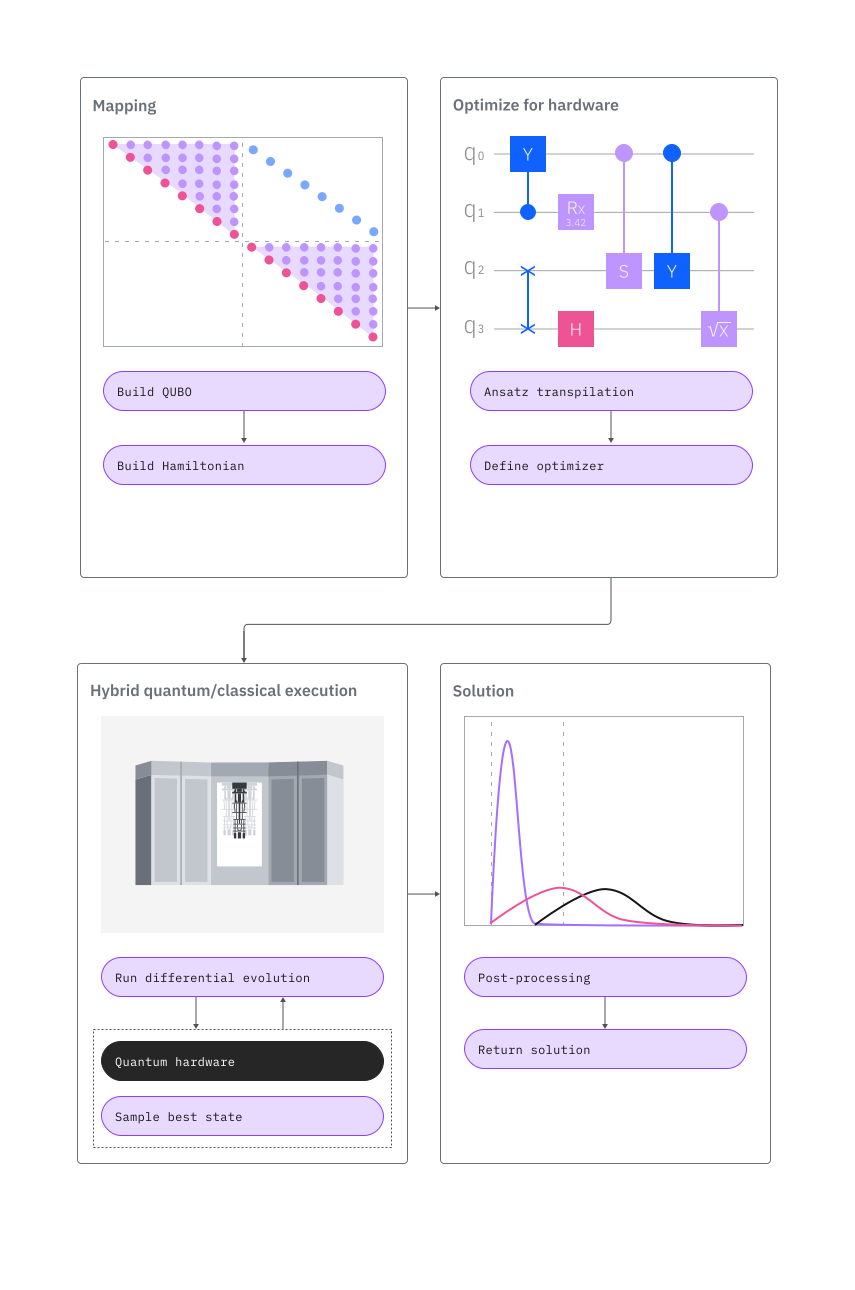
The Quantum Portfolio Optimizer function uses the Variational Quantum Eigensolver (VQE) algorithm to solve a Quadratic Unconstrained Binary Optimization (QUBO) problem, addressing dynamic portfolio optimization problems. Users simply need to provide the asset price data and define the investment constraint, then the function runs the quantum optimization process that returns a set of optimized investment trajectories.
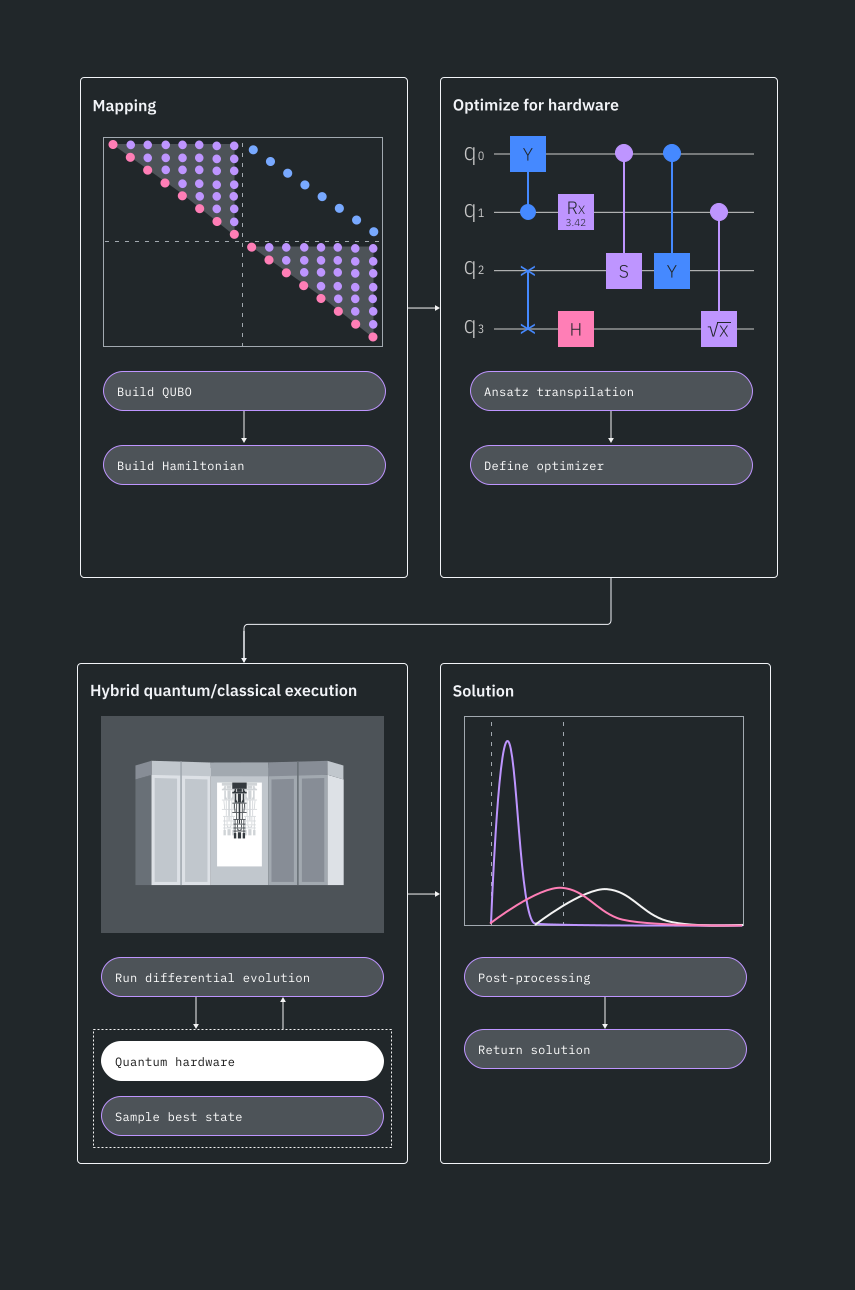
The process consists of four main stages. First, the input data is mapped to a quantum-compatible problem, constructing the QUBO of the dynamic portfolio optimization problem, and transforming it into a quantum operator (Ising Hamiltonian). Next, the input problem and the VQE algorithm are adapted to be run in the quantum hardware. The VQE algorithm is then run on the quantum hardware, and finally, the results are post-processed to provide the optimal investment trajectories. The system also includes a noise-aware (SQD-based) post-processing to maximize the quality of the output.
This Qiskit Function is based on the published manuscript by Global Data Quantum.
Get started
To learn how to load the function and run it, see Get started with Quantum Portfolio Optimizer.
Benchmarks
This function was tested under different configurations of resolution qubits, ansatz circuits, and groupings of assets from various sectors: a mix of different assets (Set 1), oil derivatives (Set 2), and IBEX35 (Set 3). See more details in the following table.
Set | Date | Assets |
|---|---|---|
| Set 1 | 01/01/2023 | 8801.T, CL=F, GBPJPY=X, ITX.MC, META, TMBMKDE-10Y, XS2239553048 |
| Set 2 | 01/06/2023 | CL=F, BZ=F, HO=F, NG=F, XOM, RB=F, 2222.SR |
| Set 3 | 01/11/2022 | ACS.MC, ITX.MC, FER.MC, ELE.MC, SCYR.MC, AENA.MC, AMS.MC |
Two key metrics were used to evaluate solution quality.
- The objective cost, which measures optimization efficiency by comparing the cost function value from each experiment with results from Gurobi (free version).
- The Sharpe ratio, which captures the risk-adjusted return of each portfolio, offering insight into the financial performance of the solutions.
Together, these metrics benchmark both computational and financial aspects of the quantum-generated portfolios.
Example | Qubits | Ansatz | Depth | Runtime Usage (s) | Total usage (s) | Objective cost | Sharpe | Gurobi objective cost | Gurobi Sharpe |
|---|---|---|---|---|---|---|---|---|---|
| Mixed Assets (Set 1, 4 time steps, 4-bit) | 112 | Tailored | 83 | 12735 | 13095 | -3.78 | 24.82 | -4.25 | 24.71 |
| Mixed Assets (Set 1,4 time steps, 4 time steps, 4-bit) | 112 | Real Amplitudes | 359 | 11739 | 11903 | -3.39 | 23.64 | -4.25 | 24.71 |
| Oil Derivatives (Set 2, 4 time steps, 3-bit) | 84 | Optimized Real Amplitudes | 78 | 6180 | 6350 | -3.73 | 19.13 | -4.19 | 21.71 |
| IBEX35 (Set 3, 4 time steps, 2-bit) | 56 | Optimized Real Amplitudes | 96 | 3314 | 3523 | -3.67 | 14.48 | -4.11 | 16.44 |
Results show that the quantum optimizer, with problem-specific ansatzes, effectively identifies efficient investment strategies across various portfolio types.
Below we detail both the population size and the number of generations specified in the optimizer_options dictionary. All other parameters were set to their default values.
Example | population_size | num_generations |
|---|---|---|
| Mixed Assets Portfolio | 90 | 20 |
| Mixed Assets Portfolio | 92 | 20 |
| Oil Derivatives Portfolio | 120 | 20 |
| IBEX35 Portfolio | 40 | 20 |
The number of generations was set to 20, as this value was found to be sufficient to reach convergence. Additionally, the default values for the optimizer's internal parameters were left unchanged, as they consistently provided good performance and are generally recommended by the literature and implementation guidelines.
Get support
If you need help, you can send an email to qpo.support@globaldataquantum.com. In your message, provide the function job ID.
Next steps
- Read the associated research paper.
-
- Visit the API reference for this Qiskit Function.
- Request access to the function by filling in this form.
- Try the Dynamic Portfolio Optimization tutorial.