Executor examples
Package versions
The code on this page was developed using the following requirements. We recommend using these versions or newer.
qiskit[all]~=2.3.0
qiskit-ibm-runtime~=0.43.1
The examples in this section illustrate some common ways to use the Executor primitive. Before running these examples, follow the instructions in Install Qiskit and Get started with Executor.
Before you begin
Some of the code examples on this page use samplex, which is part of the Samplomatic package. Therefore, before running those code block, you must install Samplomatic, as shown in the following code block. For more information, see the Samplomatic documentation.
pip install samplomatic

# For visualization support, include the visualization dependencies.
# pip install samplomatic[vis]
Example: Parameterized circuit
This example illustrates how to add circuit items with parameters, as well as how to add samplex items. It consists of these steps:
- Set up the circuit: Generate and transpile the target circuit.
- Prepare a samplex: Group gates and measurements into annotated boxes and generate the circuit template and samplex pair.
- Execute: Add a circuit item and a samplex item to a
QuantumProgramand execute both in a single job.
Set up the circuit
Prepare a three-qubit GHZ state, rotate the qubits around the Pauli-Z axis, and measures the qubits in the computational basis.
from qiskit.circuit import Parameter, QuantumCircuit
from qiskit_ibm_runtime import QiskitRuntimeService, Executor
from qiskit_ibm_runtime.quantum_program import QuantumProgram
from qiskit.transpiler import generate_preset_pass_manager
import numpy as np
from samplomatic import build
from samplomatic.transpiler import generate_boxing_pass_manager

# Generate the circuit
circuit = QuantumCircuit(3)
circuit.h(0)
circuit.h(1)
circuit.cz(0, 1)
circuit.h(1)
circuit.h(2)
circuit.cz(1, 2)
circuit.h(2)
circuit.rz(Parameter("theta"), 0)
circuit.rz(Parameter("phi"), 1)
circuit.rz(Parameter("lam"), 2)
circuit.measure_all()
Specify the backend and transpile the circuit to only use instructions supported by the QPU (referred to as an instruction set architecture (ISA) circuit).
# Initialize the service and choose a backend
service = QiskitRuntimeService()
backend = service.least_busy(operational=True, simulator=False)

# Transpile the circuit to ISA
preset_pass_manager = generate_preset_pass_manager(
    backend=backend, optimization_level=3
)
isa_circuit = preset_pass_manager.run(circuit)
Prepare the samplex
Use the generate_boxing_pass_manager convenience function and its twirling parameters to group two-qubit gates and measurements into boxes and apply twirling annotations.
boxing_pm = generate_boxing_pass_manager(
    # Add gate twirling
    enable_gates=True,
    # Add measurement twirling
    enable_measures=True,
)

boxed_circuit = boxing_pm.run(isa_circuit)
Use the build method to generate the template circuit and the samplex.
# Build the template circuit and the samplex
template_circuit, samplex = build(boxed_circuit)
Execute the circuits
Executor runs QuantumProgram objects. Each QuantumProgram can contain several items. This example adds a circuit item and a samplex item for execution. For full details, see Executor input and output.
The first step is to initialize an empty program, requesting 1024 shots for each configuration of each item.
# Generate a quantum program
program = QuantumProgram(shots=1024)
Append the circuit item to the QuantumProgram. This circuit item consists of two parts - the ISA circuit and 10 sets of its parameter values.
# Append the circuit and the parameter values to the program
program.append_circuit_item(
    isa_circuit,
    circuit_arguments=np.random.rand(10, 3),  # 10 sets of parameter values
)
Append the samplex item to the QuantumProgram with these arguments:
- The template circuit and the samplex generated by the
buildfunction - Ten sets of parameter values for the original circuit
- The number of randomizations to perform
# Append the template circuit and samplex as a samplex item
program.append_samplex_item(
    template_circuit,
    samplex=samplex,
    samplex_arguments={
        "parameter_values": np.random.rand(
            10, 3
        ),  # 10 sets of parameter values
    },
    shape=(2, 14, 10),
)
Run the Executor job
# initialize an Executor with default options
executor = Executor(mode=backend)

# Submit the job
job = executor.run(program)

# Retrieve the result
result = job.result()
Retrieve the result for each task.
# Access the results of the classical register of task #0, the CircuitItem
result_0 = result[0]["meas"]

# Access the results of the classical register of task #1, the SamplexItem
result_1 = result[1]["meas"]
Example: Perform PEC
This example shows how to use a samplex item to perform probabilistic error cancellation (PEC) for error mitigation.
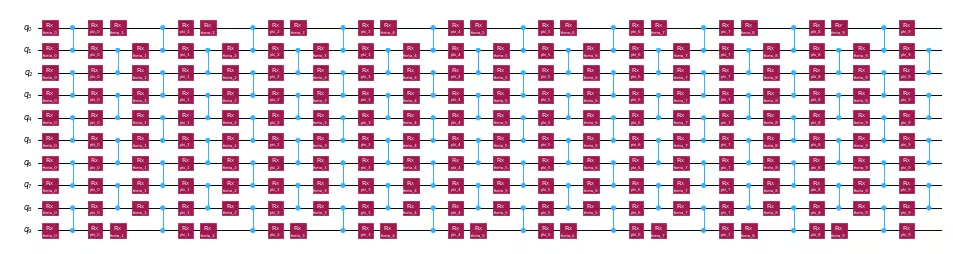
Consider a mirrored-version of a circuit with ten qubits and two unique layers of CX gates. These are the main tasks:
- Execute the circuit with twirling.
- Execute the circuit with PEC mitigation, as in the paper "Probabilistic error cancellation with sparse Pauli-Lindblad models on noisy quantum processors".
The pipeline consists of these steps:
- Set up: Generate the target circuit and group its operations into boxes.
- Learn: Learn the noise of the instructions that we want to mitigate with PEC.
- Execute: Run the circuit on a backend.
- Analyze: Post-process and analyze the results.
For comparison, we will run this mirrored circuit twice. Once with only Pauli-twirling applied, and once withe PEC mitigation applied.
The usage for this example is approximately 10 minutes on a Heron r2 processor.
Set up the circuit
Choose a backend and prepare a 10-qubit circuit.
from qiskit_ibm_runtime import QiskitRuntimeService, Executor
from qiskit_ibm_runtime.quantum_program import QuantumProgram
from qiskit.circuit import QuantumCircuit, Parameter
from qiskit.transpiler import generate_preset_pass_manager
from samplomatic.transpiler import generate_boxing_pass_manager
from samplomatic import build

# Initialize the service and choose a backend
service = QiskitRuntimeService()
backend = service.least_busy(operational=True, simulator=False)

# Prepare a circuit

num_qubits = 10
num_layers = 10

qubits = list(range(num_qubits))
circuit = QuantumCircuit(num_qubits)

for layer_idx in range(num_layers):
    circuit.rx(Parameter(f"theta_{layer_idx}"), qubits)
    for i in range(num_qubits // 2):
        circuit.cz(qubits[2 * i], qubits[2 * i + 1])

    circuit.rx(Parameter(f"phi_{layer_idx}"), qubits)
    for i in range(num_qubits // 2 - 1):
        circuit.cz(qubits[2 * i] + 1, qubits[2 * i + 1] + 1)

circuit.draw("mpl", scale=0.35, fold=100)
Output:
Combine the circuit with its inverse to create a mirror circuit.
mirror_circuit = circuit.compose(circuit.inverse())
mirror_circuit.measure_all()

mirror_circuit.draw("mpl", scale=0.35, fold=100)
Output:

Set some parameter values:
import numpy as np

parameter_values = np.random.rand(mirror_circuit.num_parameters)
Use the pass manager to transpile the circuit to become an ISA circuit.
preset_pass_manager = generate_preset_pass_manager(
    backend=backend,
    optimization_level=3,
)

isa_circuit = preset_pass_manager.run(mirror_circuit)
Next, group gates and measurements into annotated boxes. You can do this manually or use the generate_boxing_pass_manager function from Samplomatic for convenience. The first circuit will only have twirling applied and therefore only needs the Twirl annotation. The second circuit will be run with full PEC mitigation and needs both Twirl and InjectNoise annotations.
# Pass manager used to create twirled-annotated boxes.
boxing_pm = generate_boxing_pass_manager(
    enable_gates=True,
    enable_measures=True,
)

mirror_circuit_twirl = boxing_pm.run(isa_circuit)

# Pass manager used to create a new boxed circuit with
# both Twirl and InjectNoise annotations.
boxing_pm = generate_boxing_pass_manager(
    enable_gates=True,
    enable_measures=True,
    inject_noise_targets="gates",  # no measurement mitigation
    inject_noise_strategy="uniform_modification",
)

mirror_circuit_pec = boxing_pm.run(isa_circuit)
Learn the noise
To minimize the number of noise learning experiments, identify the unique instructions in the second circuit (the one with boxes annotated with InjectNoise). In defining uniqueness, two box instructions are equal if both of the following are true:
- Their content is equal, up to single-qubit gates.
- Their
Twirlannotation is equal (every other annotation is disregarded).
This leads to three unique instructions, namely the odd and even gate boxes, and the final measurement box.
from samplomatic.utils import find_unique_box_instructions

unique_box_instructions = find_unique_box_instructions(
    mirror_circuit_pec.data
)
assert len(unique_box_instructions) == 3
Initialize a NoiseLearnerV3, choose the learning parameters by setting its options, and run a noise learning job.
from qiskit_ibm_runtime.noise_learner_v3 import NoiseLearnerV3

learner = NoiseLearnerV3(backend)

learner.options.shots_per_randomization = 128
learner.options.num_randomizations = 32
learner.options.layer_pair_depths = [0, 1, 2, 4, 16, 32]

learner_job = learner.run(unique_box_instructions)

learner_job.job_id()
learner_result = learner_job.result()
Convert result to the object required by the samplex by using the result.to_dict method.
noise_maps = learner_result.to_dict(
    instructions=unique_box_instructions, require_refs=False
)
Execute the circuits
Executor runs QuantumProgram objects. Each QuantumProgram can contain several items, which are appended to the program. Each item is a task for the program to perform.
Initialize an empty program, requesting 1000 shots for each configuration of each item.
from qiskit_ibm_runtime.quantum_program import QuantumProgram

# Initialize an empty QuantumProgram
program = QuantumProgram(shots=1000)
Next, build the template circuit and samplex for mirror_circuit_twirl and append them to the program. Also request 900 randomizations from the samplex. This means that the samplex will generate 900 sets of parameters, and each set will be executed 1000 times (the number of shots) in the QPU.
This is the program's first task (result 0).
template_twirl, samplex_twirl = build(mirror_circuit_twirl)

program.append_samplex_item(
    template_twirl,
    samplex=samplex_twirl,
    samplex_arguments={"parameter_values": parameter_values},
    shape=(900,),
)
Similarly, append the template circuit and samplex built for mirror_circuit_pec, requesting 900 randomizations. This is the program's second task (result 1).
template_pec, samplex_pec = build(mirror_circuit_pec)

program.append_samplex_item(
    template_pec,
    samplex=samplex_pec,
    samplex_arguments={
        "parameter_values": parameter_values,
        "pauli_lindblad_maps": noise_maps,
        "noise_scales": {
            ref: -1.0 for ref in noise_maps
        },  # Set the scales to -1 for PEC
    },
    shape=(900,),
)
Import Executor and submit a job.
from qiskit_ibm_runtime.executor import Executor

executor = Executor(backend)
executor_job = executor.run(program)

executor_job.job_id()

executor_results = executor_job.result()
executor_results

twirl_result = executor_results[0]

print(f"Twirl result keys:\n {list(twirl_result.keys())}\n")
print(f"Shape of results: {twirl_result['meas'].shape}")

pec_result = executor_results[1]

print(f"PEC result keys:\n {list(pec_result.keys())}\n")
print(f"Shape of results: {pec_result['meas'].shape}")
Output:
Twirl result keys:
 ['meas', 'measurement_flips.meas']

Shape of results: (900, 1000, 10)
PEC result keys:
 ['meas', 'measurement_flips.meas', 'pauli_signs']

Shape of results: (900, 1000, 10)
Analyze results
Finally, post-process the results to estimate the expectation values of single-qubit Pauli-Z operators acting on each of the ten active qubits (expected value: 1.0).
# Undo measurement twirling
twirl_result_unflipped = (
    twirl_result["meas"] ^ twirl_result["measurement_flips.meas"]
)

# Calculate the expectation values of single-qubit Z operators
exp_vals = 1 - 2 * twirl_result_unflipped.mean(axis=1).mean(axis=0)

for qubit, val in enumerate(exp_vals):
    print(f"Qubit {qubit} -> {np.round(val, 2)}")
Output:
Qubit 0 -> 0.83
Qubit 1 -> 0.79
Qubit 2 -> 0.71
Qubit 3 -> 0.71
Qubit 4 -> 0.65
Qubit 5 -> 0.61
Qubit 6 -> 0.62
Qubit 7 -> 0.65
Qubit 8 -> 0.66
Qubit 9 -> 0.71
# Undo measurement twirling
pec_result_unflipped = (
    pec_result["meas"] ^ pec_result["measurement_flips.meas"]
)

# Calculate the signs for PEC mitigation
signs = np.prod((-1) ** pec_result["pauli_signs"], axis=-1)
signs = signs.reshape((signs.shape[0], 1))

# Calculate the expectation values of single-qubit Z operators as required by
# PEC mitigation
exp_vals = 1 - (2 * pec_result_unflipped.mean(axis=1) * signs).mean(axis=0)

for qubit, val in enumerate(exp_vals):
    print(f"Qubit {qubit} -> {np.round(val, 2)}")
Output:
Qubit 0 -> 1.01
Qubit 1 -> 1.0
Qubit 2 -> 0.98
Qubit 3 -> 0.99
Qubit 4 -> 1.0
Qubit 5 -> 1.0
Qubit 6 -> 0.99
Qubit 7 -> 0.98
Qubit 8 -> 0.97
Qubit 9 -> 0.97
Next steps
- Review the broadcasting overview.
- Learn how to use Executor options.
- Understand the directed execution model.
- Review the Samplomatic documentation.
- Learn about how to combine different error mitigation techniques when using directed execution model in the Probabilistic error cancellation with shaded lightcones tutorial.