# Transpile fermionic circuits
#### IMPORTANT
The concepts in this guide are currently available only in the Python API.
Equivalent functionality will be made available in the C API in a future release.
This guide explains how to transpile a [`FermionicCircuit`](../stubs/qiskit_fermions.circuit.FermionicCircuit.html.md#qiskit_fermions.circuit.FermionicCircuit) to a standard
[`QuantumCircuit`](https://quantum.cloud.ibm.com/docs/api/qiskit/qiskit.circuit.QuantumCircuit). It continues with the same time evolution
example from the [fermionic circuits guide](circuit.html.md#fermionic-circuit-explanation).
## Transpilation stages
As explained in [`qiskit_fermions.transpiler`](../pydoc/qiskit_fermions.transpiler.html.md#module-qiskit_fermions.transpiler), the preset pass managers in
this project split the transpilation into the following stages:
**Input**
: Converts the input circuit to a directed acyclic graph (DAG) data structure.
**Optimization**
: Keeps the circuit in fermionic space. These
passes use fermionic structure and commutation relations while
problem-aware knowledge remains fully available. [`FermionicTrotterization`](../stubs/qiskit_fermions.transpiler.passes.FermionicTrotterization.html.md#qiskit_fermions.transpiler.passes.FermionicTrotterization) and
[`QDriftTrotterization`](../stubs/qiskit_fermions.transpiler.passes.QDriftTrotterization.html.md#qiskit_fermions.transpiler.passes.QDriftTrotterization) are the passes that Trotterize an [`Evolution`](../stubs/qiskit_fermions.circuit.library.Evolution.html.md#qiskit_fermions.circuit.library.Evolution) gate here;
see [Optimization Passes](../pydoc/qiskit_fermions.transpiler.passes.html.md#qiskit-fermions-transpiler-passes-optimization) for the full set and
[Synthesize an Evolution gate in fermionic space](fermionic_synthesis.html.md#fermionic-synthesis-explanation) for how a product formula is chosen.
**Layout**
: Maps fermionic mode registers to quantum registers. For occupation-basis
mappings like Jordan-Wigner, each fermionic mode maps to a single qubit. This
stage also supports more general mappings where the number of qubits differs
from the number of fermionic modes.
**Synthesis**
: Converts fermionic gates to qubit operations by using the chosen fermion-to-qubit
mapping. [`FermionicGate`](../stubs/qiskit_fermions.circuit.FermionicGate.html.md#qiskit_fermions.circuit.FermionicGate) instances are transformed into sequences of
standard quantum gates. A barrier is carried through onto every qubit of each
register it touched, so it continues to separate the gates on either side of it
during the qubit stage.
**Qubit**
: Transpiles the resulting qubit circuit by using standard Qiskit methods, including
optimization, layout, and routing for your target hardware.
**Output**
: Converts the internal DAG data structure to the desired output format.
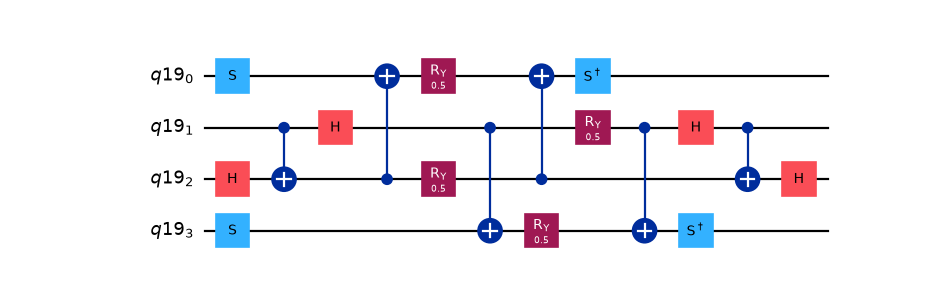
## A practical example: transpilation using Jordan-Wigner
Use the preset pass manager to transpile your fermionic circuit with the
Jordan-Wigner fermion-to-qubit mapping:
### Python
```pycon
>>> from qiskit_fermions.circuit import FermionicCircuit
>>> from qiskit_fermions.circuit.library import Evolution
>>> from qiskit_fermions.operators import FermionOperator, cre, ann
>>> from qiskit_fermions.transpiler.presets import generate_preset_jw_pass_manager
>>>
>>> # Create the same fermionic circuit from the previous guide
>>> circuit = FermionicCircuit(4)
>>> hamiltonian = FermionOperator.from_terms([
... ([cre(0), ann(2)], 0.5),
... ([cre(2), ann(0)], 0.5),
... ([cre(1), ann(3)], 0.5),
... ([cre(3), ann(1)], 0.5),
... ])
>>> hamiltonian.groups = [0, 0, 1, 1]
>>> evolution = Evolution(4, hamiltonian, time=1.0)
>>> circuit.append(evolution, circuit.register)
>>>
>>> # Generate the Jordan-Wigner transpilation pipeline
>>> pm = generate_preset_jw_pass_manager()
>>>
>>> # Transpile the fermionic circuit to a qubit circuit
>>> qubit_circuit = pm.run(circuit)
>>>
>>> # The result is a standard QuantumCircuit
>>> print(type(qubit_circuit))
```
### C
```c
// The C API for transpilation will be made available in a future release.
```
([`png`](_downloads/bcf23a9bbf5aa4a93eefaca56b71cee7/transpilation-2.png), [`hires.png`](_downloads/e6769f86f95686f515502b925f3112ee/transpilation-2.hires.png), [`pdf`](_downloads/5d44edd8f390e6372b279cedfddd1880/transpilation-2.pdf))
### Compare with the traditional workflow
The [fermionic circuits](circuit.html.md#fermionic-circuit-explanation) guide describes
how the traditional workflow performs fermion-to-qubit encoding *before*
building the [`QuantumCircuit`](https://quantum.cloud.ibm.com/docs/api/qiskit/qiskit.circuit.QuantumCircuit). Compare the two
approaches:
```pycon
>>> from qiskit_fermions.mappers.library import jordan_wigner
>>> from qiskit.circuit import QuantumCircuit
>>> from qiskit.circuit.library import PauliEvolutionGate
>>>
>>> # Map the fermionic Hamiltonian to a qubit operator
>>> qubit_hamiltonian = jordan_wigner(hamiltonian, 4).simplify()
>>>
>>> # Build the QuantumCircuit directly
>>> quantum_circuit = QuantumCircuit(4)
>>> pauli_evolution = PauliEvolutionGate(qubit_hamiltonian, time=1.0)
>>> quantum_circuit.append(pauli_evolution, quantum_circuit.qubits)
```
([`png`](_downloads/9f50f18f5babfcdb133d6d7a1d6f3ffa/transpilation-4.png), [`hires.png`](_downloads/4a814976d243057c06a2ed96de294790/transpilation-4.hires.png), [`pdf`](_downloads/8e1393f6f0c4c26c4d32da178e1d079c/transpilation-4.pdf))

Both workflows produce equivalent circuits. However, the traditional workflow
requires you to implement optimization steps manually, whereas with the
fermionic-first approach you can integrate problem-aware optimizations
into the transpilation process.
## Advanced workflows
The preset pass manager provides a convenient starting point. For more advanced
use cases, you can do the following:
- Customize the transpiler passes run during each stage.
- Choose the product formula that Trotterizes an [`Evolution`](../stubs/qiskit_fermions.circuit.library.Evolution.html.md#qiskit_fermions.circuit.library.Evolution) gate in fermionic space, either
per gate or for a whole pipeline with [`FermionicTrotterization`](../stubs/qiskit_fermions.transpiler.passes.FermionicTrotterization.html.md#qiskit_fermions.transpiler.passes.FermionicTrotterization) (see
[Synthesize an Evolution gate in fermionic space](fermionic_synthesis.html.md#fermionic-synthesis-explanation)).
- Implement custom fermion-to-qubit mappings by creating synthesis plugins (see
[`F2QSynthesisPlugin`](../stubs/qiskit_fermions.transpiler.passes.synthesis.F2QSynthesisPlugin.html.md#qiskit_fermions.transpiler.passes.synthesis.F2QSynthesisPlugin)).
- Build custom transpiler passes.