# Qiskit Fermions
`qiskit-fermions` extends the Qiskit SDK with tools for working on fermionic
systems. Within its scope it provides the following:
- Efficient data structures for the representation and manipulation of fermionic
operators in different forms
- A framework for implementing operator conversion methods (including
fermion-to-qubit encodings)
- A library of efficient implementations of common conversion methods
- A framework and library of gates for expressing fermionic circuits
- A transpilation pipeline integrated with the Qiskit transpiler process to
synthesize fermionic circuits into qubit-based circuits
Additionally, `qiskit-fermions` integrates with other tools of the ecosystem,
such as:
- [ffsim](https://qiskit-community.github.io/ffsim/) for the high-level ansatz
operators and efficient simulation of fermionic circuits (see [Relationship to
ffsim]())
## Get started
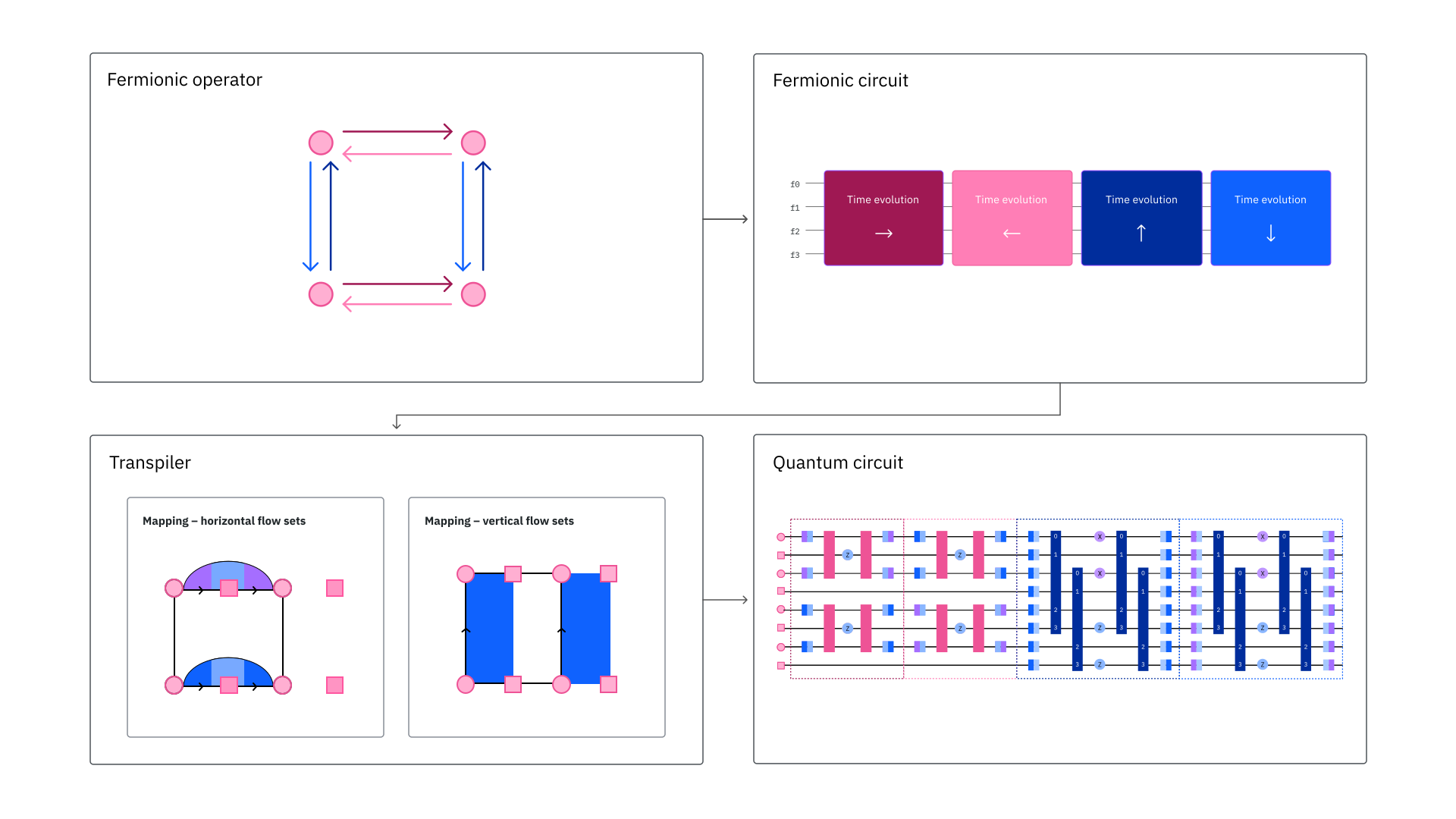
The schematic description in the image above provides a glimpse of the breadth
of features and general workflow that this package provides. You can work in the
fermionic regime with both, operator and circuit representation, before you
define a fermion-to-qubit encoding that plugs into the multi-representation
transpiler pipeline of Qiskit.
All of these features are explained in [several guides](guides/overview.html.md) to
help you get started. For an overview working through exactly the pipeline shown
above, start with the [1D Fermi-Hubbard guide](guides/1d_fermi_hubbard.html.md).
## Use case examples
Components of this package have been used in research related to the following
papers:
- The qDRIFT randomized circuit compilation in [1](#id4).
- The fermion-to-qubit synthesis during the transpilation process in [2](#id5).
## Technical discussion
### Design intentions
This package is deliberately designed to align with Qiskit: it builds on a core
implemented in Rust and provides first-party language bindings to Python and C.
Its API intends to draw parallels to Qiskit in order to seamlessly integrate
into the workflows of users with experience in programming Qiskit.
A core principle to the design of `qiskit-fermions` was the decoupling of its
fermionic circuit representation from its qubitized form. To be more precise:
the fermionic circuits are meaningful by themselves and do not require a mapping
to qubit space to be interpretable.
Furthermore, the fermionic circuit representation cannot make any assumptions
about its fermion-to-qubit encoding applied later on. Consequently, while
Jordan-Wigner retains a dominant position and role, it is not assumed to be the
\_default_ fermion-to-qubit encoding.
### Relationship to ffsim
[ffsim](https://qiskit-community.github.io/ffsim/) and `qiskit-fermions`
divide the work rather than overlap. ffsim owns the high-level ansatz operators
and their fast simulation: it constructs a UCJ or UCCSD operator from
coupled-cluster amplitudes or a parameter vector, and simulates fermionic states
in a compact fixed-particle-number space. `qiskit-fermions` owns the circuit
side: it expresses that operator as a [`FermionicCircuit`](stubs/qiskit_fermions.circuit.FermionicCircuit.html.md#qiskit_fermions.circuit.FermionicCircuit) on fermionic
modes and transpiles it into a qubit circuit through *any* fermion-to-qubit
encoding.
That last point is the reason to bring an ffsim operator here. ffsim’s own
Qiskit gates are specific to the Jordan-Wigner transformation, so lowering an
ansatz through a different encoding (a local encoding trading qubits for
shallower circuits, for instance) is what this package adds. Conversely, this
package does not reimplement the ansatz math, so [`UCJ`](stubs/qiskit_fermions.circuit.library.UCJ.html.md#qiskit_fermions.circuit.library.UCJ) and
[`UCC`](stubs/qiskit_fermions.circuit.library.UCC.html.md#qiskit_fermions.circuit.library.UCC) take an ffsim operator directly as their input.
On the simulation side, ffsim is the backend. This package’s gates and operators
implement the protocol methods ffsim’s simulation functions consume
(`_apply_unitary_`, `_linear_operator_` and `_trace_`; see
[`qiskit_fermions.protocols`](pydoc/qiskit_fermions.protocols.html.md#module-qiskit_fermions.protocols)), so ffsim’s tools work on them natively, with
no conversion step. Because ffsim depends
on PySCF, which does not support Windows, simulating on Windows means going
through the [Windows Subsystem for Linux](https://learn.microsoft.com/en-us/windows/wsl/) for now. Building operators,
mapping them and transpiling the resulting circuits need none of this and work
everywhere.
For the full picture, read the
[ffsim relationship guide](guides/ffsim.html.md#ffsim-relationship-explanation).
### Known issues
As long as the Qiskit C API has not yet reached feature parity with its Python
API, some components of this package remain exclusive to its Python API, too.
This includes the entire circuit library ([`qiskit_fermions.circuit`](pydoc/qiskit_fermions.circuit.html.md#module-qiskit_fermions.circuit)) as
well as transpiler passes ([`qiskit_fermions.transpiler`](pydoc/qiskit_fermions.transpiler.html.md#module-qiskit_fermions.transpiler)).
### Future work
- Migrate the circuit library and transpiler passes into the Rust core (and
provide a C API for interacting with them)
- Extend the library of efficient operator conversion implementations
- Extend the library of efficient operator data structures
## Contributing
The source code is available [on GitHub](https://github.com/Qiskit/qiskit-fermions).
The developer guide is located at [CONTRIBUTING.md](https://github.com/Qiskit/qiskit-fermions/blob/main/CONTRIBUTING.md)
in the root of this project’s repository.
By participating, you are expected to uphold Qiskit’s [code of conduct](https://github.com/Qiskit/qiskit/blob/main/CODE_OF_CONDUCT.md).
## Citing this package
If you use this package in your research, use the [CITATION.bib](https://github.com/Qiskit/qiskit-fermions/blob/main/CITATION.bib) file in
this project’s repository to cite the appropriate reference(s).
## License
[Apache License 2.0](https://github.com/Qiskit/qiskit-fermions/blob/main/LICENSE.txt)
## Deprecation policy
This package follows [semantic versioning](https://semver.org/). Breaking changes
are made only occasionally, to improve the user experience. When possible, old
interfaces are kept and marked as deprecated for as long as they can co-exist
with the new ones. Each substantial improvement, breaking change, or deprecation
is documented in the [Release Notes](release-notes.html.md#release-notes).
## References
* **[1]** Samuele Piccinelli, et al., [Quantum chemistry with provable convergence via randomized sample-based Krylov quantum diagonalization](https://arxiv.org/abs/2508.02578v2), arXiv:2508.02578 [quant-ph].
* **[2]** Anthony Gandon, et al., [Stabilizer-based quantum simulation of fermion dynamics with local qubit encodings](https://arxiv.org/abs/2512.11418v2), arXiv:2512.11418 [quant-ph].