Low-overhead error detection with spacetime codes
Usage estimate: 1 minute on a Heron r3 processor (NOTE: This is an estimate only. Your runtime may vary.)
Learning outcomes
After completing this tutorial, you can expect to understand the following information:
- How spacetime Pauli checks detect logical errors in Clifford circuits, and how postselecting on their syndromes boosts the fidelity of a sampled distribution.
- How to use the
qiskit-paulicepackage to find and insert hardware-efficient checks automatically withget_check_qubits,NoiseModel, andadd_pauli_checks. - How to estimate the fidelity of a stabilizer state by sampling its stabilizers and postselecting on check syndromes.
- How to run the full error-detection workflow on IBM Quantum® hardware and compare noisy and postselected fidelities.
Prerequisites
It is recommended that you familiarize yourself with these topics:
- Hardware fundamentals for utility-scale quantum computing.
- The Clifford and stabilizer formalism, including how a stabilizer group describes a pure stabilizer state.
Background
Low-overhead error detection with spacetime codes [1] by Simon Martiel and Ali Javadi-Abhari introduces a method for detecting logical errors in Clifford-dominated circuits that sits between full error correction and lighter-weight error mitigation. The idea builds on coherent Pauli checks (CPC) from Single-shot error mitigation by coherent Pauli checks [2] by van den Berg and others. In both approaches, a Clifford "payload" circuit is entangled with ancilla qubits to check certain invariants. Measuring the ancillas produces a syndrome that reports whether an error was detected during execution. Keeping only the samples with no detected error improves the fidelity of the sampled distribution, at the cost of a reduced postselection rate.
The key difference between coherent Pauli checks and spacetime checks is the operators they measure. Coherent Pauli checks measure time-localized, high-weight operators. On qubit topologies with limited connectivity, such as heavy hex, those checks need many SWAP gates and often make the circuit too deep to run in practice. Implementing the checks as spacetime codes instead distributes each check across the payload circuit in space and time. This yields a hardware-efficient encoding that stays effective at detecting logical errors while keeping the qubit and depth overhead low.
What the qiskit-paulice package does
The qiskit-paulice package automates the construction of these checks so that you do not have to build them by hand. Its primary role is to find and insert valid spacetime Pauli checks at the locations in a circuit that maximize error detection while minimizing qubit overhead. A check is valid when its operators leave the logical action of the payload circuit unchanged, low-weight when it uses few entangling gates, and effective when it detects a large portion of the errors, relative to the noise the check itself introduces. The package scores candidate checks against a noise model and commits the best ones to the circuit. This tutorial uses three API methods:
get_check_qubitsinspects a backend coupling map and returns target and ancilla qubit pairs. A check ontarget_qubits[i]usesancilla_qubits[i].NoiseModel.from_backendbuilds a rough noise model from backend benchmark data. The model scores candidate checks, so an exact, learned noise model is not required. For a learned Pauli-Lindblad model, seeNoiseModel.from_pauli_lindblad_maps.add_pauli_checksfinds and inserts checks into a circuit. It returns a sequence ofCheckedCircuitobjects with an increasing number of checks, and each object provides aget_postselection_methodthat maps a measured bitstring to a syndrome vector. Thecostargument selects the function that scores a check (gamma, the sampling overhead of the postselected inverse noise channel, orLER, the logical error rate). Themethodargument selects the search strategy (windowed,genetic, orwindowed_genetic). This tutorial usescost="gamma"andmethod="windowed", which together give deterministic, reproducible check selection.
Estimate fidelity from stabilizer sampling
To measure how well the error detection works, you can estimate the fidelity of the stabilizer state that the circuit ideally prepares against the noisy state that the hardware actually outputs. The projector onto a pure stabilizer state equals the uniform average over the elements of its stabilizer group :
Substituting this into the fidelity gives the fidelity of as the average expectation value of every stabilizer with respect to :
For larger problems, enumerating all stabilizers is infeasible, so you can estimate the fidelity from a random sample. Drawing stabilizers uniformly at random from gives an unbiased estimation:
Because a Clifford circuit prepares a stabilizer state, you can estimate its fidelity directly from sampled expectation values of its stabilizers. This tutorial first walks through the workflow on a simulator with a small circuit, then runs the same workflow on hardware with a deeper circuit. As circuits include more non-Clifford operations, the number of valid checks shrinks quickly, so the method works best for Clifford-dominated circuits.
Requirements
Before starting this tutorial, be sure you have the following installed:
- Qiskit SDK v2.0 or later, with visualization support
- Qiskit Runtime v0.40 or later (
pip install qiskit-ibm-runtime) - Qiskit Aer v0.17 or later (
pip install qiskit-aer) - Qiskit Paulice (
pip install qiskit-paulice) - tqdm (
pip install tqdm)
Setup
Import the required libraries and define the helper functions that are not available as imports. The random_clifford_circuit function builds a brickwork random Clifford payload, append_basis_rotation rotates a circuit so that a stabilizer is measured in the computational basis, expectation computes a stabilizer expectation value from sampled counts, and cum_mean_sem tracks the running fidelity estimate.
# Standard library imports
import random
import time

# External libraries
import matplotlib.pyplot as plt
import numpy as np
from tqdm import tqdm

# Qiskit
from qiskit import QuantumCircuit
from qiskit.quantum_info import Clifford, Pauli, PauliList
from qiskit.result import sampled_expectation_value
from qiskit.transpiler import generate_preset_pass_manager
from qiskit.visualization import plot_coupling_map

# Qiskit Aer
from qiskit_aer import AerSimulator
from qiskit_aer.noise import NoiseModel as AerNoiseModel
from qiskit_aer.noise import ReadoutError, depolarizing_error

# Qiskit IBM Runtime
from qiskit_ibm_runtime import QiskitRuntimeService
from qiskit_ibm_runtime import SamplerV2 as Sampler

# Qiskit Paulice
from qiskit_paulice import add_pauli_checks
from qiskit_paulice.layout import get_check_qubits
from qiskit_paulice.noise_models import NoiseModel
def random_clifford_circuit(
num_qubits: int, depth: int, rng: np.random.Generator
) -> QuantumCircuit:
"""Brickwork random Clifford on `num_qubits`, with `depth` CZ layers."""
qc = QuantumCircuit(num_qubits)
qc.h(range(num_qubits))
for d in range(depth):
for i in range(d % 2, num_qubits - 1, 2):
qc.cz(i, i + 1)
for q in range(num_qubits):
if rng.integers(0, 2):
qc.sx(q)
if rng.integers(0, 2):
qc.s(q)
if rng.integers(0, 2):
qc.sx(q)
return qc
def append_basis_rotation(
circuit: QuantumCircuit, pauli: Pauli
) -> QuantumCircuit:
"""Strip measurements, append basis rotations for `pauli`, and re-measure."""
out = circuit.remove_final_measurements(inplace=False)
for q in range(pauli.num_qubits):
if pauli.x[q]:
if pauli.z[q]:
out.sdg(q)
out.h(q)
out.measure_all()
return out
def expectation(counts: dict, pauli: Pauli) -> float:
"""Expectation value of `pauli` from counts measured in the Z basis.
Pads with identity on any qubits beyond the support of `pauli`, such as the
check ancillas that appear in the postselected counts.
"""
if not counts:
return float("nan")
n = pauli.num_qubits
sign = -1 if int(pauli.phase) % 4 == 2 else 1
total = len(next(iter(counts)))
label = "".join(
"Z" if q < n and (pauli.x[q] or pauli.z[q]) else "I"
for q in range(total - 1, -1, -1)
)
return sign * sampled_expectation_value(counts, label)
def cum_mean_sem(values: np.ndarray):
"""Cumulative mean and standard error of the mean, ignoring NaNs."""
valid = ~np.isnan(values)
total = np.cumsum(np.where(valid, values, 0.0))
total_sq = np.cumsum(np.where(valid, values**2, 0.0))
count = np.maximum(np.cumsum(valid).astype(float), 1)
mean = total / count
sem = np.sqrt(np.maximum(total_sq / count - mean**2, 0) / count)
return np.where(np.cumsum(valid) > 0, mean, np.nan), semSmall-scale simulator example
This section walks through the full workflow on a noisy simulator. It uses backend benchmark data to choose a qubit layout and a noise model, finds checks automatically, and uses postselection on the sampled distribution to show the fidelity improvement.
Step 1: Map classical inputs to a quantum problem
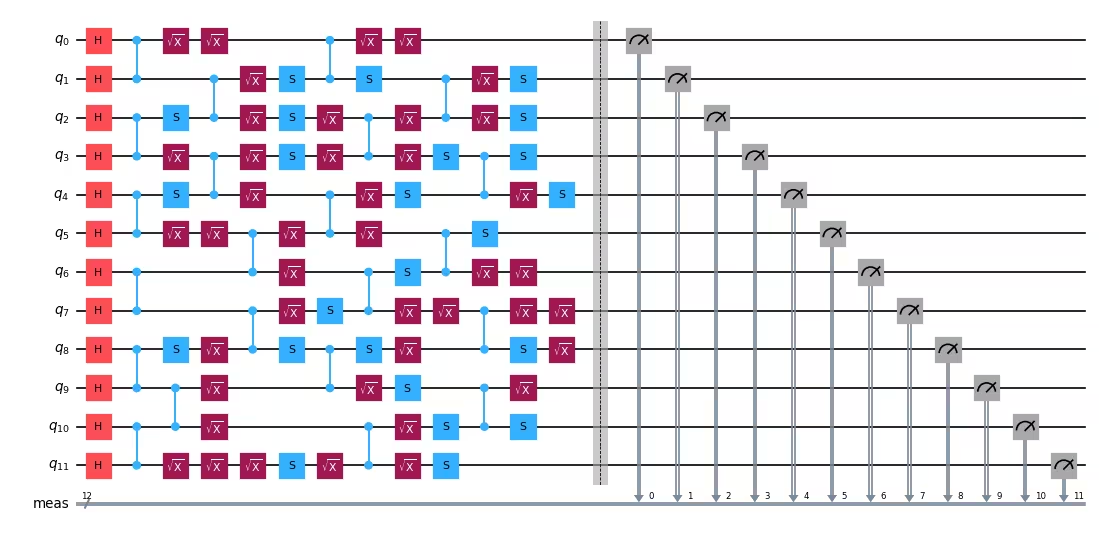
The payload circuit is a shallow one-dimensional brickwork random Clifford circuit. Because the circuit is Clifford, it prepares a stabilizer state whose fidelity you can estimate directly from sampled stabilizer expectation values. Start with a shallow circuit so that the checks are easy to visualize in the next step.
num_qubits = 12
depth = 4
seed = 1764
rng = np.random.default_rng(seed)
np.random.seed(seed)

circuit = random_clifford_circuit(num_qubits, depth, rng)
circuit.measure_all()
circuit.draw("mpl", fold=-1, scale=0.6)
Output:
Step 2: Optimize for quantum hardware execution
Mapping the circuit to hardware sets the physical qubit layout, the noise model that scores candidate checks, and the checks themselves.
First, choose a one-dimensional qubit layout on the Heron r3 QPU ibm_boston. The layout zig-zags diagonally through the coupling graph to maximize the number of available ancilla qubits. The get_check_qubits function returns target and ancilla pairs, where a check on target_qubits[i] uses ancilla_qubits[i].
In the coupling graph that follows, the green qubits are payload qubits and the orange qubits are the ancillas that implement the checks. Qubits with an adjacent ancilla are used as target qubits for checks.
service = QiskitRuntimeService()
backend = service.backend("ibm_marrakesh")

# Choose a layout and pair each available target qubit with a neighboring ancilla
layout = [68, 69, 78, 89, 90, 91, 98, 111, 112, 113, 119, 133]
target_qubits, ancilla_qubits = get_check_qubits(backend, layout)
num_checks = len(target_qubits)

print(f"Target qubits:  {target_qubits}")
print(f"Ancilla qubits: {ancilla_qubits}")
plot_coupling_map(
    num_qubits=backend.num_qubits,
    qubit_coordinates=getattr(
        backend.configuration(), "qubit_coordinates", None
    ),
    coupling_map=backend.configuration().coupling_map,
    figsize=(12, 12),
    qubit_color=[
        "#4CAF50"
        if i in set(layout)
        else "#FF9800"
        if i in set(ancilla_qubits)
        else "#DDDDDD"
        for i in backend.coupling_map.graph.node_indices()
    ],
    qubit_size=220,
    line_width=2,
    font_size=90,
)
Output:
Target qubits:  [68, 69, 89, 91, 111, 113, 133]
Ancilla qubits: [67, 70, 88, 92, 110, 114, 132]

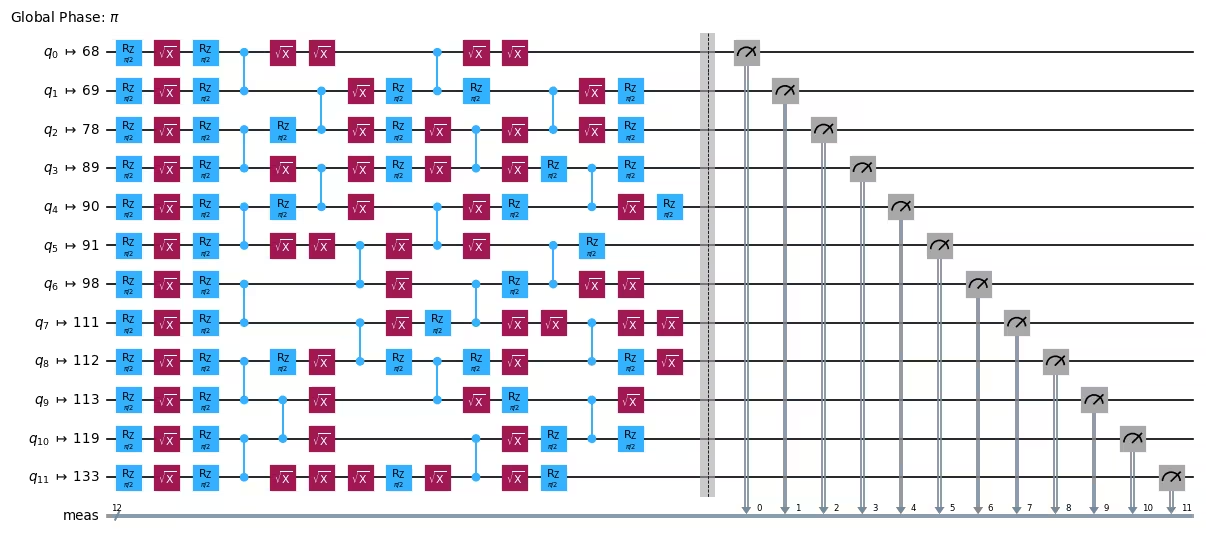
With the backend and layout chosen, transpile the payload into an instruction set architecture (ISA) circuit. Setting the layout and translating the gates into the native gate set of ibm_boston is enough here.
pm = generate_preset_pass_manager(
    optimization_level=0, backend=backend, initial_layout=layout
)
circuit_isa = pm.run(circuit)
circuit_isa.draw("mpl", fold=-1, scale=0.6)
Output:
Next, model how the gate and readout noise on the backend affects execution. The noise model determines where in the circuit a check captures the most error. A more accurate model improves the detection, but it is usually not necessary to learn one by sampling the QPU. The model that follows infers a uniform depolarizing channel for gate and readout noise from qiskit-ibm-runtime benchmark data.
noise_model = NoiseModel.from_backend(
    backend, layout, uniform_gate_noise=True
)
print(noise_model)
Output:
NoiseModel(gate_noise=0.19074977552838765, readout_noise=0.1016845703125, idling_noise=None)
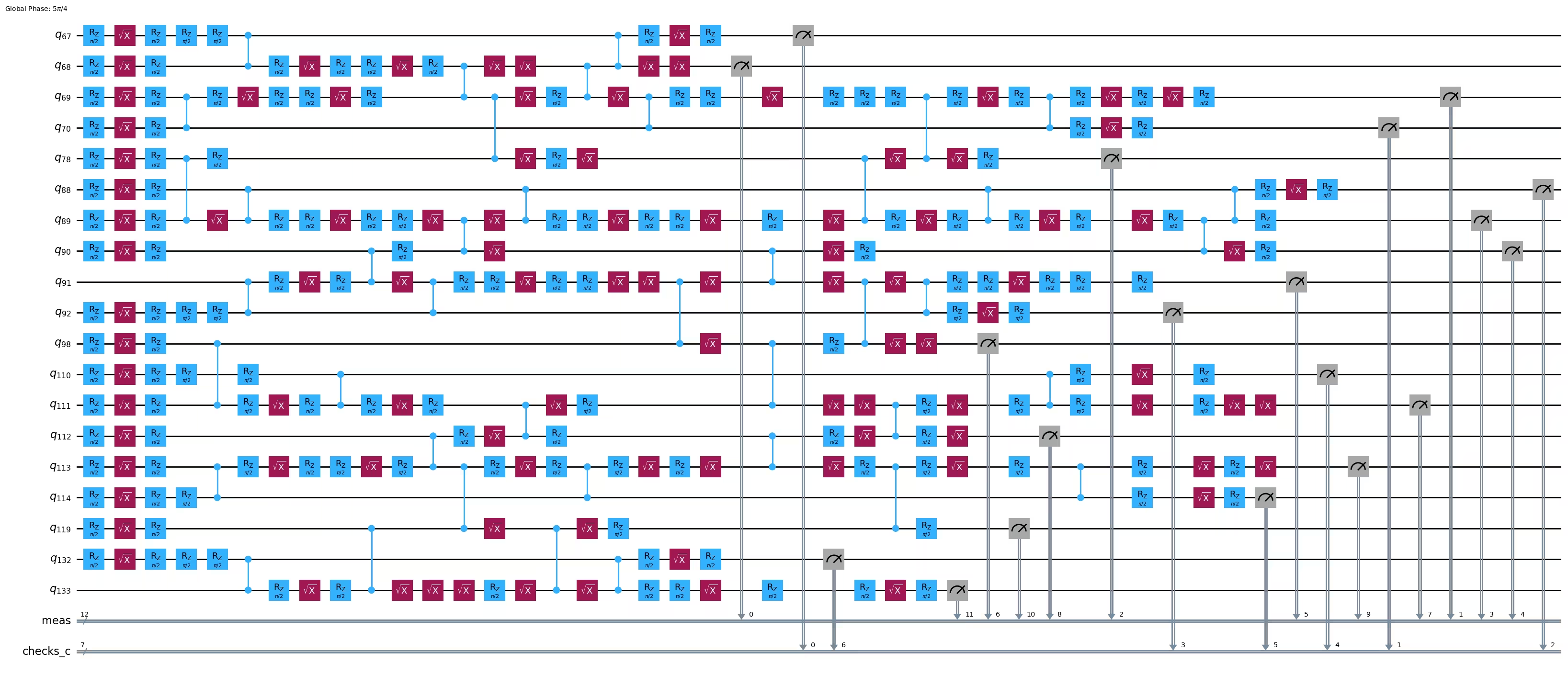
Now add checks to the circuit. The add_pauli_checks function takes the Clifford payload, the list of target qubits, and the noise model. The ancilla_qubits argument tells the function which physical ancilla to pair with each target. Checks are added in the order the target qubits appear, so the final layout of the checked circuit is layout + ancilla_qubits. To run an output circuit with fewer (i) checks, the final layout is layout + ancilla_qubits[:i].
The output of add_pauli_checks is a sequence of circuits with an increasing number of checks, from no checks up to one check on every target qubit. The visualization confirms that the checks use the specified target and ancilla pairs. For details on finding good checks, see Sections II to IV of the supplementary information in reference [1].
checked = add_pauli_checks(
    circuit_isa,
    target_qubits,
    noise_model,
    ancilla_qubits=ancilla_qubits,
    cost="gamma",
    method="windowed",
    seed=seed,
)

print(f"Physical layout of payload and ancillas: {layout + ancilla_qubits}")
print("Checked circuit:")
checked[-1].circuit.draw("mpl", fold=-1, idle_wires=False)
Output:
Physical layout of payload and ancillas: [68, 69, 78, 89, 90, 91, 98, 111, 112, 113, 119, 133, 67, 70, 88, 92, 110, 114, 132]
Checked circuit:
Step 3: Execute using Qiskit primitives
To make the effect of gate noise visible, increase the depth of the payload and sample a subset of its stabilizers. Each stabilizer is generally not qubit-wise commuting with the others, so a single set of checks is not valid for two different stabilizers. Rather than group stabilizers into commuting sets, find a good set of checks for each stabilizer independently. Sampling stabilizers uniformly at random gives an unbiased fidelity estimate.
Build the deeper circuit and draw a random sample of its stabilizers.
depth = 24
num_stabilizers = 20
num_shots = 1_000

circuit = random_clifford_circuit(num_qubits, depth, rng)

# Build the full stabilizer group, then sample from it uniformly at random
circ_no_meas = circuit.remove_final_measurements(inplace=False)
stabilizer_group = PauliList([Pauli("I" * num_qubits)])
for generator in (
    Pauli(label) for label in Clifford(circ_no_meas).to_labels(mode="S")
):
    stabilizer_group = stabilizer_group + stabilizer_group.compose(generator)

keep = np.where(
    stabilizer_group.x.any(axis=1) | stabilizer_group.z.any(axis=1)
)[0]
chosen = np.random.default_rng(seed).choice(
    keep, size=min(num_stabilizers, len(keep)), replace=False
)
stabilizers = [stabilizer_group[int(i)] for i in chosen]

two_qubit_depth = circuit.depth(lambda x: x.operation.num_qubits == 2)
print(
    f"Sampled {len(stabilizers)} stabilizers of a {circuit.num_qubits}-qubit "
    f"circuit with two-qubit depth {two_qubit_depth}: "
    f"{{{stabilizers[0]}, {stabilizers[1]}, ...}}"
)
Output:
Sampled 20 stabilizers of a 12-qubit circuit with two-qubit depth 24: {-XYXZIZXYIIXZ, -XZYYIIXZXYYY, ...}
For each sampled stabilizer, rotate the circuit so that the stabilizer is measured in the computational basis, transpile it onto the backend, and find a good set of checks. The target and ancilla pairs are shuffled together for each stabilizer so that each target keeps its ancilla. Remember that checks are committed sequentially in the order the target qubits are given, and a committed check is not changed as more checks are added.
noisy_circuits = []
checked_circuits = []
depths_2q = []
t0 = time.time()
for i, pauli in enumerate(tqdm(stabilizers)):
    noisy_circuits.append(pm.run(append_basis_rotation(circuit, pauli)))
    # Shuffle target and ancilla pairs together so each target keeps its ancilla
    targets, ancillas = zip(
        *random.sample(
            list(zip(target_qubits, ancilla_qubits, strict=True)),
            k=len(target_qubits),
        ),
        strict=True,
    )
    checked_circuits.append(
        add_pauli_checks(
            noisy_circuits[-1],
            list(targets),
            noise_model,
            ancilla_qubits=list(ancillas),
            cost="gamma",
            method="windowed",
            seed=seed + 1 + i,
        )
    )
    depths_2q.append(
        checked_circuits[-1][-1].circuit.depth(lambda x: len(x.qubits) == 2)
    )

print(
    f"Added {num_checks} checks to {len(stabilizers)} circuits "
    f"in {(time.time() - t0):.0f}s."
)
print(
    f"On average, two-qubit depth increased from "
    f"{circuit.depth(lambda x: len(x.qubits) == 2)} to {int(np.mean(depths_2q))} "
    f"when adding {num_checks} checks."
)
Output:
100%|██████████| 20/20 [00:14<00:00, 1.37it/s]
Added 7 checks to 20 circuits in 15s.
On average, two-qubit depth increased from 24 to 33 when adding 7 checks.
Sample the bare payload and the checked circuits with Qiskit Aer. The simulator uses the same depolarizing model that scored the checks, so the noise that the checks target is the noise that the simulator applies.
aer_nm = AerNoiseModel()
aer_nm.add_all_qubit_quantum_error(
    depolarizing_error(noise_model.gate_noise, 2), ["cz"]
)
p = noise_model.readout_noise
aer_nm.add_all_qubit_readout_error(ReadoutError([[1 - p, p], [p, 1 - p]]))
noisy_sim = AerSimulator(method="stabilizer", noise_model=aer_nm)

counts = []
for i, checked_circ_result in enumerate(tqdm(checked_circuits)):
    noisy_counts = (
        noisy_sim.run(
            noisy_circuits[i], shots=num_shots, seed_simulator=seed * i + 1
        )
        .result()
        .get_counts()
    )
    checked_counts_per_variant = []
    for k, ck in enumerate(checked_circ_result):
        variant_counts = (
            noisy_sim.run(
                ck.circuit, shots=num_shots, seed_simulator=seed * i + 2 + k
            )
            .result()
            .get_counts()
        )
        checked_counts_per_variant.append(variant_counts)
    counts.append((noisy_counts, checked_counts_per_variant))
Output:
100%|██████████| 20/20 [00:19<00:00, 1.00it/s]
Step 4: Post-process and return result in desired classical format
Each check uses entangling gates between one ancilla and one target. The ancilla starts in , so stabilizes its input. Propagating forward through the checked circuit yields a Pauli operator on the output whose non-identity terms define the check's support. A check passes when the bits in its support have even parity. A sample is kept only when every check passes.
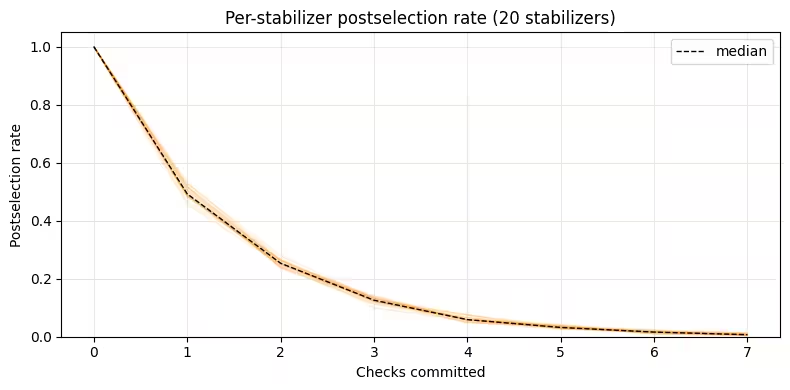
The get_postselection_method of each CheckedCircuit returns a function that maps a measured bitstring to a syndrome vector. Keep the samples whose syndrome is zero for every check, and discard the rest. The chart that follows shows that adding more checks lowers the postselection rate. A lower postselection rate needs more shots to reach a target accuracy, so there is a tradeoff between detection capability and sampling cost. The rate appears to converge, which indicates that additional checks contribute less detection capability.
rate_per_variant = []
kept_per_stab = []
for i, (_, checked_counts_per_variant) in enumerate(counts):
    rates = []
    kept_at_num_checks = None
    for k, variant_counts in enumerate(checked_counts_per_variant):
        ps_fn = checked_circuits[i][k].get_postselection_method()
        kept = {
            bs: n for bs, n in variant_counts.items() if not ps_fn(bs).any()
        }
        rates.append(sum(kept.values()) / num_shots)
        if k == num_checks:
            kept_at_num_checks = kept
    rate_per_variant.append(rates)
    kept_per_stab.append(kept_at_num_checks)

max_len = max(len(s) for s in rate_per_variant)
rates_arr = np.full((len(rate_per_variant), max_len), np.nan)
for i, s in enumerate(rate_per_variant):
    rates_arr[i, : len(s)] = s
ks = np.arange(max_len)

fig, ax = plt.subplots(figsize=(8, 4))
ax.plot(ks, rates_arr.T, color="#ff8c00", alpha=0.15, linewidth=1)
ax.plot(
    ks,
    np.nanmedian(rates_arr, axis=0),
    color="black",
    linewidth=1,
    linestyle="--",
    label="median",
)
ax.set_xlabel("Checks committed")
ax.set_ylabel("Postselection rate")
ax.set_ylim((0, 1.05))
ax.set_title(
    f"Per-stabilizer postselection rate ({len(rates_arr)} stabilizers)"
)
ax.legend()
ax.grid(True, alpha=0.3)
plt.tight_layout()
plt.show()
Output:
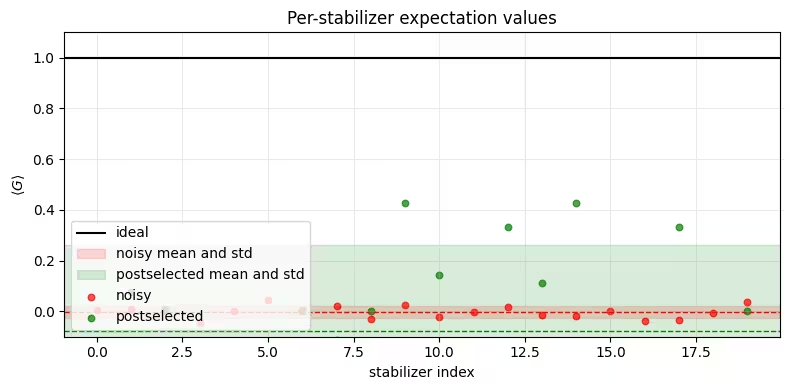
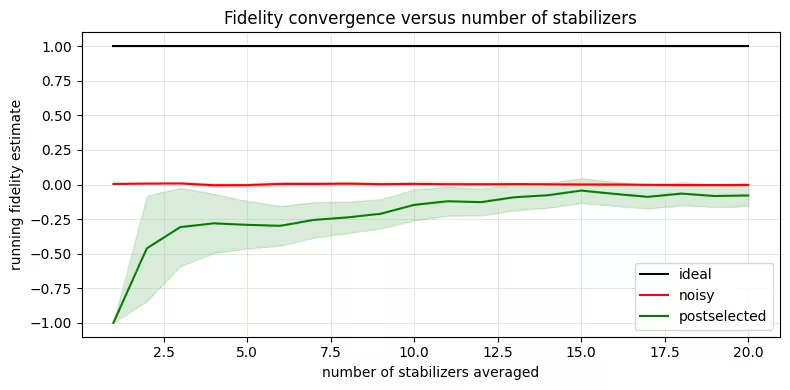
Now compare the fidelity of the bare noisy state with the postselected state. Postselecting only the samples with no detected error raises the expectation value of every stabilizer, and therefore the estimated fidelity. The postselected values use fewer samples than the raw values, yet the expectation values are more accurate and the sampled variance is lower.
results = []
for i, ((noisy_counts, _), kept) in enumerate(
    zip(counts, kept_per_stab, strict=True)
):
    results.append(
        (
            expectation(noisy_counts, stabilizers[i]),
            expectation(kept, stabilizers[i]),
            sum(kept.values()) / num_shots,
        )
    )

fidelity_noisy = float(np.nanmean([r[0] for r in results]))
fidelity_postsel = float(np.nanmean([r[1] for r in results]))
psr = float(np.mean([r[2] for r in results]))
print(
    f"ideal fidelity:          1.0\n"
    f"noisy fidelity:          {fidelity_noisy:.4f}\n"
    f"postselected fidelity:   {fidelity_postsel:.4f}\n"
    f"mean postselection rate: {psr:.3f}"
)

evs_ideal = np.ones(len(results))
evs_noisy = np.array([r[0] for r in results])
evs_post = np.array([r[1] for r in results])
idx = np.arange(len(results))


def strip(ax, ys, color, label):
    m, s = np.nanmean(ys), np.nanstd(ys)
    ax.axhspan(
        m - s, m + s, color=color, alpha=0.15, label=f"{label} mean and std"
    )
    ax.axhline(m, color=color, linewidth=1, linestyle="--")


fig, ax = plt.subplots(figsize=(8, 4))
ax.axhline(np.nanmean(evs_ideal), color="black", linewidth=1.5, label="ideal")
strip(ax, evs_noisy, "red", "noisy")
strip(ax, evs_post, "green", "postselected")
ax.scatter(idx, evs_noisy, color="red", s=22, alpha=0.7, label="noisy")
ax.scatter(
    idx,
    evs_post,
    color="green",
    s=22,
    alpha=0.7,
    label="postselected",
)
ax.set_xlabel("stabilizer index")
ax.set_ylabel(r"$\langle G \rangle$")
ax.set_ylim((-0.1, 1.1))
ax.set_title("Per-stabilizer expectation values")
ax.legend(loc="lower left")
ax.grid(True, alpha=0.3)
plt.tight_layout()
plt.show()

M = np.arange(1, len(results) + 1)
fig, ax = plt.subplots(figsize=(8, 4))
for ys, color, label in [
    (evs_ideal, "black", "ideal"),
    (evs_noisy, "red", "noisy"),
    (evs_post, "green", "postselected"),
]:
    cm, sem = cum_mean_sem(ys)
    ax.plot(M, cm, color=color, linewidth=1.5, label=label)
    ax.fill_between(M, cm - sem, cm + sem, color=color, alpha=0.15)
ax.set_xlabel("number of stabilizers averaged")
ax.set_ylabel("running fidelity estimate")
ax.set_title("Fidelity convergence versus number of stabilizers")
ax.legend()
ax.grid(True, alpha=0.3)
plt.tight_layout()
plt.show()
Output:
ideal fidelity:          1.0
noisy fidelity:          -0.0020
postselected fidelity:   -0.0790
mean postselection rate: 0.007
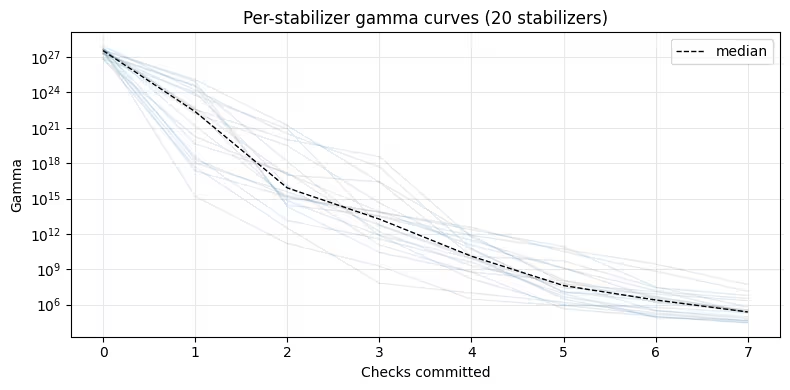
The gamma score reports how much of the modeled noise channel remains undetected by the checks. Plotting the gamma score against the number of committed checks shows how the detection capability improves as each check is added. A gamma curve that converges toward 1.0 indicates that additional checks detect little extra error, which matches the convergence seen in the postselection rate.
stab_scores = [
    [variant.cost for variant in checked_circ_result]
    for checked_circ_result in checked_circuits
]
max_len = max(len(s) for s in stab_scores)
scores = np.full((len(stab_scores), max_len), np.nan)
for i, s in enumerate(stab_scores):
    scores[i, : len(s)] = s
ks = np.arange(max_len)

fig, ax = plt.subplots(figsize=(8, 4))
ax.plot(ks, scores.T, color="#4682b4", alpha=0.15, linewidth=1)
ax.plot(
    ks,
    np.nanmedian(scores, axis=0),
    color="black",
    linewidth=1,
    linestyle="--",
    label="median",
)
ax.set_xlabel("Checks committed")
ax.set_ylabel("Gamma")
ax.set_yscale("log")
ax.set_title(f"Per-stabilizer gamma curves ({len(scores)} stabilizers)")
ax.legend()
ax.grid(True, alpha=0.3, which="both")
plt.tight_layout()
plt.show()
Output:
Large-scale hardware example
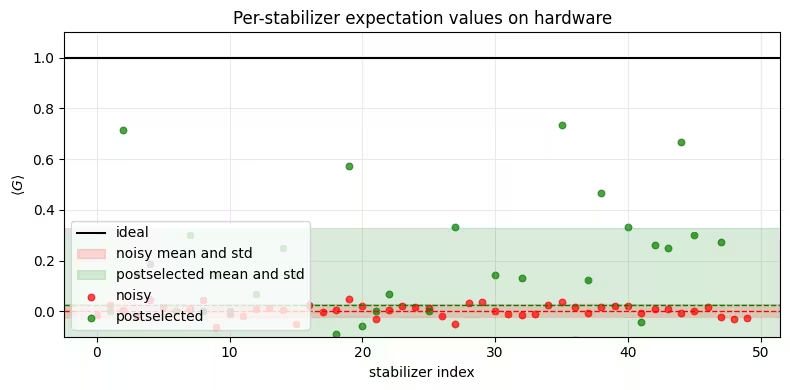
The same workflow runs on hardware with a deeper payload and more stabilizers. This section reuses the backend, layout, target and ancilla pairs, noise model, and pass manager from the simulator example, then submits the sampled circuits to the QPU in a single job. Because the circuit is deeper, gate noise has a larger effect, and the fidelity gain from postselection is more pronounced.
The parameters that follow set the depth, the number of stabilizers, and the number of shots. Increase hw_num_stabilizers for a more precise fidelity estimate at the cost of more circuits per job, and adjust the layout to use more qubits if you want a larger payload.
Steps 1-4 (compressed into a single code block)
The first cell builds the deeper payload, samples its stabilizers, finds the fully checked circuit for each one, and submits one Sampler job that contains both the bare and the checked circuits. Each job carries the tag TUT_ASPC so that you can find it later. See Add job tags for more on tagging jobs.
# -------------------------Step 1: build a deeper payload and sample its stabilizers-------------------------
hw_depth = 72
hw_num_stabilizers = 50
hw_num_shots = 2_000

hw_circuit = random_clifford_circuit(num_qubits, hw_depth, rng)
hw_no_meas = hw_circuit.remove_final_measurements(inplace=False)
hw_group = PauliList([Pauli("I" * num_qubits)])
for generator in (
    Pauli(label) for label in Clifford(hw_no_meas).to_labels(mode="S")
):
    hw_group = hw_group + hw_group.compose(generator)
keep = np.where(hw_group.x.any(axis=1) | hw_group.z.any(axis=1))[0]
chosen = np.random.default_rng(seed).choice(
    keep, size=min(hw_num_stabilizers, len(keep)), replace=False
)
hw_stabilizers = [hw_group[int(i)] for i in chosen]

# -------------------------Step 2: transpile and add the fully checked circuit per stabilizer-------------------------
hw_noisy_circuits = []
hw_checked_circuits = []
for i, pauli in enumerate(tqdm(hw_stabilizers)):
    bare = pm.run(append_basis_rotation(hw_circuit, pauli))
    hw_noisy_circuits.append(bare)
    variants = add_pauli_checks(
        bare,
        target_qubits,
        noise_model,
        ancilla_qubits=ancilla_qubits,
        cost="gamma",
        method="windowed",
        seed=seed + 1 + i,
    )
    hw_checked_circuits.append(variants[-1])  # keep the fully checked circuit

# -------------------------Step 3: submit one Sampler job with the bare and checked circuits-------------------------
sampler = Sampler(mode=backend)
sampler.options.default_shots = hw_num_shots
sampler.options.environment.job_tags = ["TUT_ASPC"]

pubs = hw_noisy_circuits + [cc.circuit for cc in hw_checked_circuits]
job = sampler.run(pubs)
print(f"Submitted job {job.job_id()} with {len(pubs)} circuits")
Output:
100%|██████████| 50/50 [03:34<00:00, 4.29s/it]
Submitted job d91ge2vqq29s738nkm00 with 100 circuits
After the job completes, retrieve the results and postselect the checked counts. Compute the noisy and postselected fidelities as the average stabilizer expectation value over the sampled stabilizers.
# -------------------------Step 4: postselect and compare fidelity-------------------------
result = job.result()
n_stab = len(hw_stabilizers)

hw_results = []
for i in range(n_stab):
    noisy_counts = result[i].join_data().get_counts()
    checked_counts = result[n_stab + i].join_data().get_counts()
    ps_fn = hw_checked_circuits[i].get_postselection_method()
    kept = {bs: c for bs, c in checked_counts.items() if not ps_fn(bs).any()}
    hw_results.append(
        (
            expectation(noisy_counts, hw_stabilizers[i]),
            expectation(kept, hw_stabilizers[i]),
            sum(kept.values()) / sum(checked_counts.values()),
        )
    )

hw_fidelity_noisy = float(np.nanmean([r[0] for r in hw_results]))
hw_fidelity_postsel = float(np.nanmean([r[1] for r in hw_results]))
hw_psr = float(np.mean([r[2] for r in hw_results]))
print(
    f"noisy fidelity:          {hw_fidelity_noisy:.4f}\n"
    f"postselected fidelity:   {hw_fidelity_postsel:.4f}\n"
    f"mean postselection rate: {hw_psr:.3f}"
)

hw_noisy = np.array([r[0] for r in hw_results])
hw_post = np.array([r[1] for r in hw_results])
idx = np.arange(n_stab)

fig, ax = plt.subplots(figsize=(8, 4))
ax.axhline(1.0, color="black", linewidth=1.5, label="ideal")
strip(ax, hw_noisy, "red", "noisy")
strip(ax, hw_post, "green", "postselected")
ax.scatter(idx, hw_noisy, color="red", s=22, alpha=0.7, label="noisy")
ax.scatter(
    idx,
    hw_post,
    color="green",
    s=22,
    alpha=0.7,
    label="postselected",
)
ax.set_xlabel("stabilizer index")
ax.set_ylabel(r"$\langle G \rangle$")
ax.set_ylim((-0.1, 1.1))
ax.set_title("Per-stabilizer expectation values on hardware")
ax.legend(loc="lower left")
ax.grid(True, alpha=0.3)
plt.tight_layout()
plt.show()
Output:
noisy fidelity:          0.0032
postselected fidelity:   0.0268
mean postselection rate: 0.008
Next steps
If you found this work interesting, you might be interested in the following material:
- The tutorial on repetition codes for an introduction to quantum error correction.
- The
qiskit-paulicepackage for the full check-finding API. - The paper Low-overhead error detection with spacetime codes for the theory behind the checks.
References
- [1] Martiel, S., & Javadi-Abhari, A. (2025). Low-overhead error detection with spacetime codes. arXiv preprint arXiv:2504.15725.
- [2] van den Berg, E., Bravyi, S., Gambetta, J. M., Jurcevic, P., Maslov, D., & Temme, K. (2023). Single-shot error mitigation by coherent Pauli checks. Physical Review Research, 5(3), 033193.