How to generate exact sampling coefficients
This how-to guide is intended to show users how they can generate exact sampling coefficients to be used in reconstructing the simulated expectation value of the original circuit.
First, we set up a simple cutting problem following the first tutorial.
import numpy as np
from qiskit.circuit.library import efficient_su2
from qiskit.quantum_info import SparsePauliOp

from qiskit_addon_cutting import (
    partition_problem,
    generate_cutting_experiments,
)
circuit = efficient_su2(4, entanglement="linear", reps=2)
circuit.assign_parameters([0.8] * len(circuit.parameters), inplace=True)
observable = SparsePauliOp(["ZZZZ"])
circuit.draw("mpl", scale=0.8)Output:
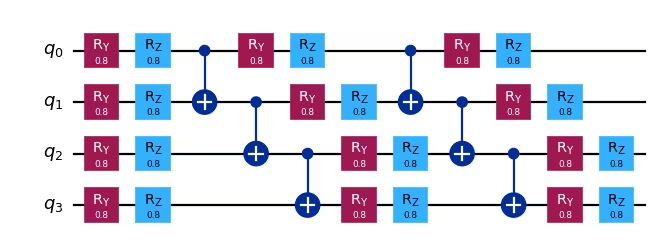
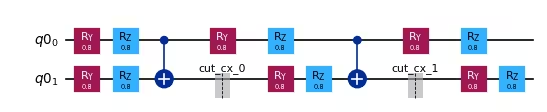
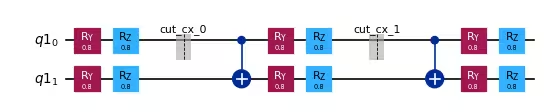
Partition the circuit between qubits 1 and 2 by cutting 2 CNOT gates.
partitioned_problem = partition_problem(
    circuit=circuit, partition_labels="AABB", observables=observable.paulis
)
subcircuits = partitioned_problem.subcircuits
bases = partitioned_problem.bases
subobservables = partitioned_problem.subobservables
subcircuits["A"].draw("mpl", scale=0.6)
Output:
subcircuits["B"].draw("mpl", scale=0.6)Output:
Demonstrate how to obtain all weights exactly
If you wish to calculate all weights exactly, no matter how small, you can achieve this by passing infinity (np.inf) to num_samples:
subexperiments, coefficients = generate_cutting_experiments(
    circuits=subcircuits,
    observables=subobservables,
    num_samples=np.inf,
)
coefficients
Output:
[(np.float64(0.24999999999999992), <WeightType.EXACT: 1>),
 (np.float64(0.24999999999999992), <WeightType.EXACT: 1>),
 (np.float64(0.24999999999999992), <WeightType.EXACT: 1>),
 (np.float64(-0.24999999999999992), <WeightType.EXACT: 1>),
 (np.float64(0.24999999999999992), <WeightType.EXACT: 1>),
 (np.float64(-0.24999999999999992), <WeightType.EXACT: 1>),
 (np.float64(0.24999999999999992), <WeightType.EXACT: 1>),
 (np.float64(0.24999999999999992), <WeightType.EXACT: 1>),
 (np.float64(0.24999999999999992), <WeightType.EXACT: 1>),
 (np.float64(-0.24999999999999992), <WeightType.EXACT: 1>),
 (np.float64(0.24999999999999992), <WeightType.EXACT: 1>),
 (np.float64(-0.24999999999999992), <WeightType.EXACT: 1>),
 (np.float64(0.24999999999999992), <WeightType.EXACT: 1>),
 (np.float64(0.24999999999999992), <WeightType.EXACT: 1>),
 (np.float64(0.24999999999999992), <WeightType.EXACT: 1>),
 (np.float64(-0.24999999999999992), <WeightType.EXACT: 1>),
 (np.float64(0.24999999999999992), <WeightType.EXACT: 1>),
 (np.float64(-0.24999999999999992), <WeightType.EXACT: 1>),
 (np.float64(-0.24999999999999992), <WeightType.EXACT: 1>),
 (np.float64(-0.24999999999999992), <WeightType.EXACT: 1>),
 (np.float64(-0.24999999999999992), <WeightType.EXACT: 1>),
 (np.float64(0.24999999999999992), <WeightType.EXACT: 1>),
 (np.float64(-0.24999999999999992), <WeightType.EXACT: 1>),
 (np.float64(0.24999999999999992), <WeightType.EXACT: 1>),
 (np.float64(0.24999999999999992), <WeightType.EXACT: 1>),
 (np.float64(0.24999999999999992), <WeightType.EXACT: 1>),
 (np.float64(0.24999999999999992), <WeightType.EXACT: 1>),
 (np.float64(-0.24999999999999992), <WeightType.EXACT: 1>),
 (np.float64(0.24999999999999992), <WeightType.EXACT: 1>),
 (np.float64(-0.24999999999999992), <WeightType.EXACT: 1>),
 (np.float64(-0.24999999999999992), <WeightType.EXACT: 1>),
 (np.float64(-0.24999999999999992), <WeightType.EXACT: 1>),
 (np.float64(-0.24999999999999992), <WeightType.EXACT: 1>),
 (np.float64(0.24999999999999992), <WeightType.EXACT: 1>),
 (np.float64(-0.24999999999999992), <WeightType.EXACT: 1>),
 (np.float64(0.24999999999999992), <WeightType.EXACT: 1>)]
Demonstrate how to find the minimum num_samples needed to retrieve all exact weights for 2 CNOT cuts
When num_samples is set to a finite number, each weight whose absolute value is above a threshold of 1 / num_samples will be evaluated exactly. The remaining weights -- those in the tail of the distribution -- will then be sampled from, resulting in at most num_samples unique weights.
In the case of a CNOT gate -- or any gate equivalent to it up to single-qubit unitaries -- each of the six weights of the quasi-probability decomposition have the same magnitude, so each gets sampled with a probability of :
print(f"Mapping probabilities for a CNOT decomposition: {bases[0].probabilities}")Output:
Mapping probabilities for a CNOT decomposition: [0.16666667 0.16666667 0.16666667 0.16666667 0.16666667 0.16666667]
In this example, we have cut two CNOT gates. Given that the probability of any given mapping in a CNOT decomposition is , the probability of any given mapping in the joint distribution combining the two cut CNOT gates is . Therefore, we need to take at least weights in order to retrieve all exact weights from generate_cutting_experiments.
from qiskit_addon_cutting.qpd import QPDBasis
from qiskit.circuit.library.standard_gates import CXGate

qpd_basis_cx = QPDBasis.from_instruction(CXGate())


def _min_nonzero(seq, /):
    """Return the minimum value in a sequence, ignoring values near zero."""
    return min(x for x in seq if not np.isclose(x, 0))


num_cx_cuts = 2

print(
    f"Number of samples needed to retrieve exact weights: {1 / _min_nonzero(qpd_basis_cx.probabilities)**num_cx_cuts}"
)
Output:
Number of samples needed to retrieve exact weights: 36.0
Observe the coefficient weights returned from generate_cutting_experiments are WeightType.EXACT
Above, we determined 36 samples would trigger the coefficients to be returned as exact. Here we set num_samples to exactly 36 to test this.
subexperiments, coefficients = generate_cutting_experiments(
    circuits=subcircuits,
    observables=subobservables,
    num_samples=36,
)
coefficients
Output:
[(np.float64(0.25), <WeightType.EXACT: 1>),
 (np.float64(0.25), <WeightType.EXACT: 1>),
 (np.float64(0.25), <WeightType.EXACT: 1>),
 (np.float64(-0.25), <WeightType.EXACT: 1>),
 (np.float64(0.25), <WeightType.EXACT: 1>),
 (np.float64(-0.25), <WeightType.EXACT: 1>),
 (np.float64(0.25), <WeightType.EXACT: 1>),
 (np.float64(0.25), <WeightType.EXACT: 1>),
 (np.float64(0.25), <WeightType.EXACT: 1>),
 (np.float64(-0.25), <WeightType.EXACT: 1>),
 (np.float64(0.25), <WeightType.EXACT: 1>),
 (np.float64(-0.25), <WeightType.EXACT: 1>),
 (np.float64(0.25), <WeightType.EXACT: 1>),
 (np.float64(0.25), <WeightType.EXACT: 1>),
 (np.float64(0.25), <WeightType.EXACT: 1>),
 (np.float64(-0.25), <WeightType.EXACT: 1>),
 (np.float64(0.25), <WeightType.EXACT: 1>),
 (np.float64(-0.25), <WeightType.EXACT: 1>),
 (np.float64(-0.25), <WeightType.EXACT: 1>),
 (np.float64(-0.25), <WeightType.EXACT: 1>),
 (np.float64(-0.25), <WeightType.EXACT: 1>),
 (np.float64(0.25), <WeightType.EXACT: 1>),
 (np.float64(-0.25), <WeightType.EXACT: 1>),
 (np.float64(0.25), <WeightType.EXACT: 1>),
 (np.float64(0.25), <WeightType.EXACT: 1>),
 (np.float64(0.25), <WeightType.EXACT: 1>),
 (np.float64(0.25), <WeightType.EXACT: 1>),
 (np.float64(-0.25), <WeightType.EXACT: 1>),
 (np.float64(0.25), <WeightType.EXACT: 1>),
 (np.float64(-0.25), <WeightType.EXACT: 1>),
 (np.float64(-0.25), <WeightType.EXACT: 1>),
 (np.float64(-0.25), <WeightType.EXACT: 1>),
 (np.float64(-0.25), <WeightType.EXACT: 1>),
 (np.float64(0.25), <WeightType.EXACT: 1>),
 (np.float64(-0.25), <WeightType.EXACT: 1>),
 (np.float64(0.25), <WeightType.EXACT: 1>)]