Ground-state energy estimation of the Heisenberg chain with VQE
Usage estimate: 37 minutes on a Heron processor (NOTE: This is an estimate only. Your runtime might vary.)
Background
This tutorial shows how to build, deploy, and run a development workflow called a Qiskit pattern for simulating a Heisenberg chain and estimating its ground-state energy using the SPSA optimizer.
Requirements
Before starting this tutorial, ensure that you have the following installed:
- Qiskit SDK v2.0 or later, with visualization support
- Qiskit Runtime v0.44 or later (
pip install qiskit-ibm-runtime)
Setup
import numpy as np
import matplotlib.pyplot as plt
from typing import Sequence

from qiskit import QuantumCircuit
from qiskit.quantum_info import SparsePauliOp
from qiskit.primitives import BaseEstimatorV2
from qiskit.circuit.library import XGate
from qiskit.circuit.library import efficient_su2
from qiskit.transpiler import PassManager
from qiskit.transpiler.preset_passmanagers import generate_preset_pass_manager
from qiskit.transpiler.passes.scheduling import (
    ALAPScheduleAnalysis,
    PadDynamicalDecoupling,
)
from qiskit_ibm_runtime import QiskitRuntimeService, Session, EstimatorV2


def visualize_results(results):
    plt.plot(results["cost_history"], lw=2)
    plt.xlabel("Number of function evaluations")
    plt.ylabel("Energy")
    plt.show()
Step 1: Map classical inputs to a quantum problem
- Input: Number of spins
- Output: Ansatz and Hamiltonian modeling the Heisenberg chain
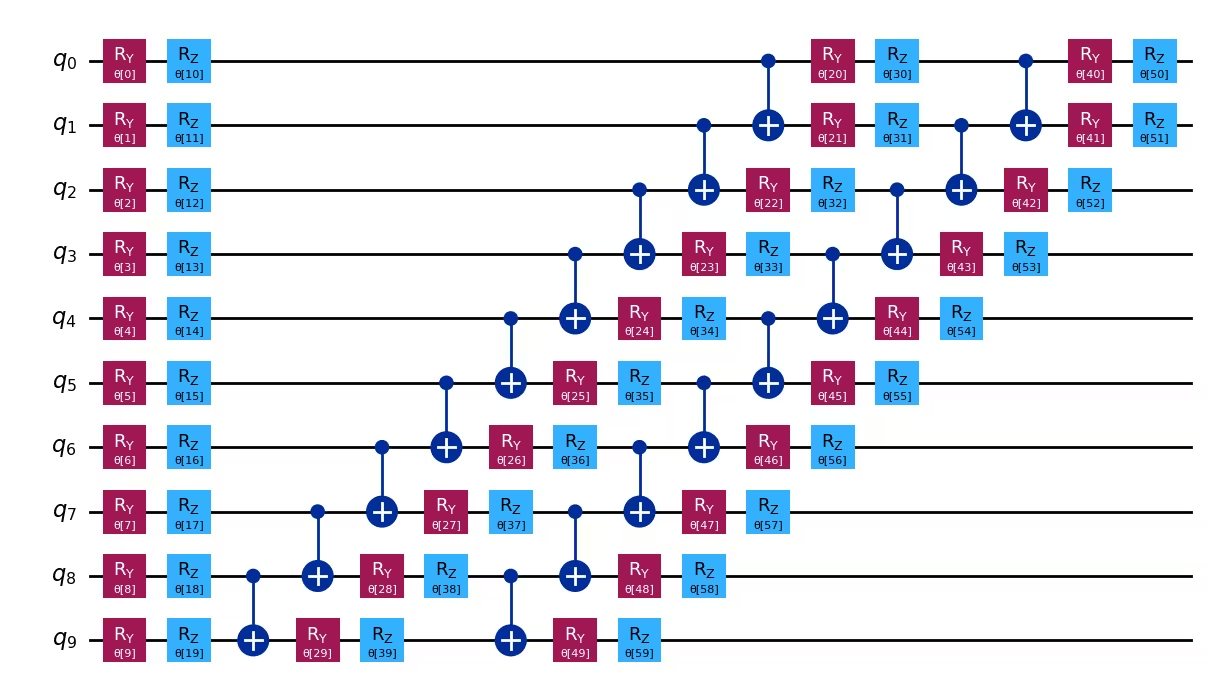
Construct an ansatz and Hamiltonian that model a 10-spin Heisenberg chain. First, we import some generic packages and create some helper functions.
num_spins = 10
ansatz = efficient_su2(num_qubits=num_spins, reps=2)

service = QiskitRuntimeService(
    channel="ibm_cloud",
    token="<YOUR_API_TOKEN>",  # Replace with your actual API token
    instance="<YOUR_INSTANCE_NAME>",  # Replace with your instance name if needed
)
backend = service.least_busy(
    operational=True, min_num_qubits=num_spins, simulator=False
)

coupling = backend.target.build_coupling_map()
reduced_coupling = coupling.reduce(list(range(num_spins)))

edge_list = reduced_coupling.graph.edge_list()
ham_list = []

for edge in edge_list:
    ham_list.append(("ZZ", edge, 0.5))
    ham_list.append(("YY", edge, 0.5))
    ham_list.append(("XX", edge, 0.5))

for qubit in reduced_coupling.physical_qubits:
    ham_list.append(("Z", [qubit], np.random.random() * 2 - 1))

hamiltonian = SparsePauliOp.from_sparse_list(ham_list, num_qubits=num_spins)

ansatz.draw("mpl", style="iqp")
Output:
Step 2: Optimize problem for quantum hardware execution
- Input: Abstract circuit, observable
- Output: Target circuit and observable, optimized for the selected QPU
Use the generate_preset_pass_manager function from Qiskit to automatically generate an optimization routine for our circuit with respect to the selected QPU. We choose optimization_level=3, which provides the highest level of optimization of the preset pass managers. We also include ALAPScheduleAnalysis and PadDynamicalDecoupling scheduling passes to suppress decoherence errors.
target = backend.target
pm = generate_preset_pass_manager(optimization_level=3, target=target)
pm.scheduling = PassManager(
    [
        ALAPScheduleAnalysis(durations=target.durations()),
        PadDynamicalDecoupling(
            durations=target.durations(),
            dd_sequence=[XGate(), XGate()],
            pulse_alignment=target.pulse_alignment,
        ),
    ]
)
isa_ansatz = pm.run(ansatz)
isa_observable = hamiltonian.apply_layout(isa_ansatz.layout)
isa_ansatz.draw("mpl", scale=0.6, style="iqp", fold=-1, idle_wires=False)
Output:

Step 3: Execute using Qiskit primitives
- Input: Target circuit and observable
- Output: Results of optimization
Minimize the estimated ground-state energy of the system by optimizing the circuit parameters. Use the Estimator primitive from Qiskit Runtime to evaluate the cost function during optimization.
Since we optimized the circuit for the backend in Step 2, we can avoid doing transpilation on the Runtime server by setting skip_transpilation=True and passing the optimized circuit. For this demo, we will run on a QPU using qiskit-ibm-runtime primitives. To run with qiskit statevector-based primitives, replace the block of code using Qiskit Runtime primitives with the commented block.
In this tutorial we use Simultaneous Perturbation Stochastic Approximation (SPSA), which is a gradient-based optimizer. Next we give a brief introduction to it, and provide the code to implement SPSA using Qiskit v2.0.
Introducing SPSA
Simultaneous Perturbation Stochastic Approximation (SPSA) [1] is an optimization algorithm that approximates the entire gradient vector using only two function calls at each iteration. Let be the cost function with parameters to be optimized, and be the parameter vector at the step of the iteration. To compute the gradient, a random vector of size is created, where each element , , is uniformly sampled from . Next, each element of the random vector is multiplied with a small value to create a random perturbation. The gradient is then estimated as
Intuitively, since a random perturbation is applied during the gradient estimation, it is expected that small deviations in the exact values of coming from noise can be tolerated and accounted for. In fact, SPSA is particularly known to be robust against noise, and requires only two hardware calls for each iteration. It is, therefore, one of the highly preferred optimizers for implementing variational algorithms.
In this tutorial, the hyperparameters for the iteration, and , are computed as and , where the constant values are taken as , , , , and . These values are selected from [2]. Appropriate tuning of hyperparameters is necessary for extracting a good performance out of SPSA.
def spsa(
    fun, x0, args=(), A=30, alpha=0.9, a=0.3, c=0.1, gamma=0.4, maxiter=100
):
    nparams = len(x0)
    x = np.copy(x0)

    for i in range(maxiter):
        a_i = a / (A + i + 1) ** alpha
        c_i = c / (i + 1) ** gamma
        delta_i = np.random.choice([-1, 1], nparams)

        # two hardware calls
        eval_1 = fun(x + c_i * delta_i, *args)
        eval_2 = fun(x - c_i * delta_i, *args)

        # compute the gradient and update the parameters
        grad = (eval_1 - eval_2) / (2 * c_i) * np.reciprocal(delta_i)
        x = x - a_i * grad

    return x
def cost_func(
params: Sequence,
ansatz: QuantumCircuit,
hamiltonian: SparsePauliOp,
estimator: BaseEstimatorV2,
cost_history_dict: dict,
) -> float:
"""Ground state energy evaluation."""
energy = (
estimator.run([(ansatz, hamiltonian, [params])]).result()[0].data.evs
)
cost_history_dict["iters"] += 1
cost_history_dict["prev_vector"] = list(params)
cost_history_dict["cost_history"].append(float(energy[0]))
print(
f"Fx Iters. done: {cost_history_dict['iters']} [Current cost: {round(energy[0], 5)}]",
end="\r",
)
return energy
def solve(x0, isa_ansatz, isa_observable, maxiter=150):
cost_history_dict = {
"prev_vector": None,
"iters": 0,
"cost_history": [],
"y_min": None,
}
# Evaluate the problem using a QPU via Qiskit IBM Runtime
with Session(backend=backend) as session:
estimator = EstimatorV2(mode=session)
estimator.skip_transpilation = True
x_opt = spsa(
cost_func,
x0=x0,
args=(isa_ansatz, isa_observable, estimator, cost_history_dict),
maxiter=maxiter,
)
y_min = cost_func(
x_opt, isa_ansatz, isa_observable, estimator, cost_history_dict
)
return y_min, cost_history_dictnp.random.seed(42)
num_params = ansatz.num_parameters
params = 2 * np.pi * np.random.random(num_params)Here we set the maxiter = 50. Note that since each iteration requires two calls to the function to compute the gradient, the total number of function calls will be . The maxiter can be increased to any higher value for better energy estimation.
maxiter = 50
spsa_min, spsa_history = solve(
    params, isa_ansatz, isa_observable, maxiter=maxiter
)
Output:
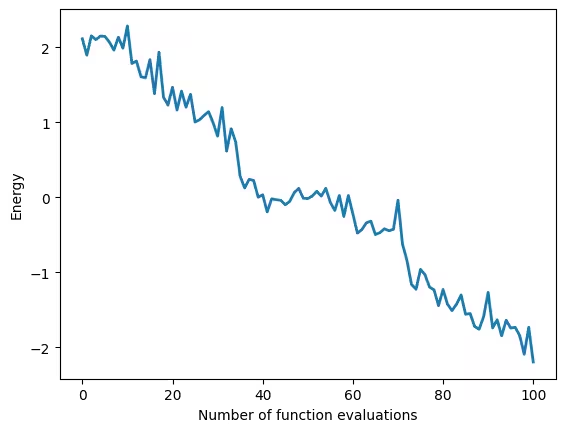
Fx Iters. done: 101 [Current cost: -2.19621]
Step 4: Post-process and return result in desired classical format
- Input: Ground-state energy estimates during optimization
- Output: Estimated ground-state energy
print(f"Estimated ground state energy: {spsa_min}")Output:
Estimated ground state energy: [-2.19621239]
results = {
    "spsa": spsa_history,
}

visualize_results(spsa_history)
Output:
References
[1] Spall, J. C. (2002). Implementation of the simultaneous perturbation algorithm for stochastic optimization. IEEE Transactions on Aerospace and Electronic Systems, 34(3), 817-823.
[2] Sahin, M. Emre, et al. (2025). Qiskit Machine Learning: an open-source library for quantum machine learning tasks at scale on quantum hardware and classical simulators. arXiv:2505.17756.
Next steps
If you found this work interesting, you might be interested in the following material:
- Find the ground-state energy of a sparse Hamiltonian by following the SQD tutorial
- Take the Variational algorithm design course in IBM Learning