Introduction
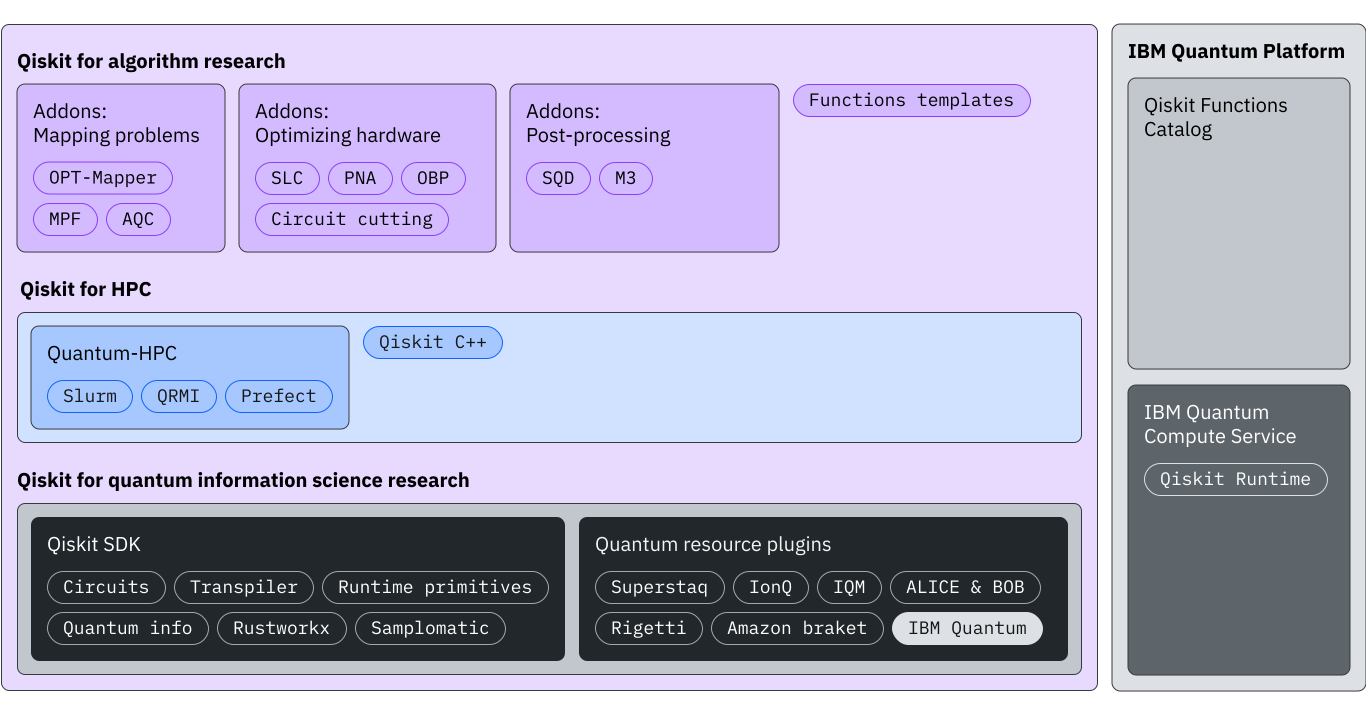
Welcome to the documentation for Qiskit and IBM Quantum. Find how-to guides, specific use-case tutorials, and API references for your quantum research and development. Use Qiskit and its related packages and tools to build, optimize, and execute workflows on the IBM® fleet of quantum computers.
Get started
Build a quantum circuit in under two minutes - no sign-in or API key required.
Start building
Try end-to-end examples that apply Qiskit to common quantum computing use cases.
Browse tutorials
Tools by task
Map problem to circuits
- AQC-Tensor - A Qiskit addon for building time evolution circuits
- Qiskit circuit library - The Qiskit SDK standard library of gates and circuit instructions
- Optimization mapper - A Qiskit addon for mapping optimization problems to circuits and operators
- Quantum optimization best practices - A collection of guidelines to run quantum optimization workloads
- Device benchmarking
Prepare and optimize workloads
- Transpiler - Translate circuit instructions to execute on quantum hardware, with options for efficient layout and routing
- Dynamic circuits - Perform certain tasks, such as long-range entanglement and state preparation, at constant depth
- Dynamical decoupling - Reduce decoherence errors on idle qubits
- Operator backpropagation - Reduce circuit depth by trimming operations at the cost of increased measurements
Debug
- Noisy estimator analyzer tool - Gauge the expected performance of quantum workloads
- Local testing mode - Simulate smaller or Cliffordized circuits to assess performance
Execute on hardware
- Estimator and Sampler primitives - Handles hardware execution and returns samples or expectation values, with some built-in error suppression/mitigation support
- Execution modes - Efficiently schedule workload execution
- Executor primitive - Generate and execute circuit variants based on the input samplex directive
Manage noise
- Samplomatic - Fine-tune error mitigation in specific circuit regions
- Noise learner - Learn and return the sparse Pauli-Lindblad noise model, which can be used for error mitigation methods like PEA, PEC, and PNA
- Pauli twirling - Convert coherent noise to better characterized stochastic noise
- Matrix-free measurement mitigation - Reduce measurement errors
- Probabilistic error cancellation - Mitigate errors by statistically canceling noise, resulting in an unbiased expectation value at the expense of greater overhead
- Zero-noise extrapolation - Mitigate errors by amplifying noise and extrapolating corrected expectation values
- Twirled readout error extinction - Use twirling to reduce measurement error
- Propagated noise absorption - Characterize and propagate the effects of noise into an observable
- Shaded lightcones - Reduce the overhead of PEC error mitigation
Post-process results
- Sample-based quantum diagonalization - Post-process samples to refine results in simulation workloads
- Multi-product formulas - Refine expectation values in workloads simulating time evolution
- Measurement post-selection - Refine samples by post-selecting known "bad" bitstrings
Qiskit Functions
- Algorithmiq Tensor-Network Error Mitigation Function
- Q-CTRL Performance Management Function
- QEDMA Qiskit Function QESEM
- Q-CTRL Optimization Solver
Support
Find answers to frequently-asked questions, learn how to report bugs, discover communities to join, and more.
Get help