Tensor-network error mitigation (TEM): A Qiskit Function by Algorithmiq
See the API reference
Qiskit Functions are an experimental feature available only to IBM Quantum® Premium Plan, Flex Plan, and On-Prem (via IBM Quantum Platform API) Plan users. They are in preview release status and subject to change.
The code on this page was developed using the following requirements. We recommend using these versions or newer.
qiskit[all]~=2.5.1
Overview
Algorithmiq’s Tensor-network Error Mitigation (TEM) method is a hybrid quantum-classical algorithm designed for performing noise mitigation entirely at the classical post-processing stage. With TEM, the user can compute the expectation values of observables mitigating the inevitable noise-induced errors that occur on quantum hardware with increased accuracy and cost efficiency, making it a highly attractive option for quantum researchers and industry practitioners alike.
The method consists of constructing a tensor network representing the inverse of the global noise channel affecting the state of the quantum processor and then applying the map to informationally complete measurement outcomes acquired from the noisy state to obtain unbiased estimators for the observables.
As an advantage, TEM leverages informationally complete measurements to give access to a vast set of mitigated expectation values of observables and has optimal sampling overhead on the quantum hardware, as described in Filippov et al. (2023), arXiv:2307.11740, and Filippov et al. (2024), arXiv:2403.13542. The measurement overhead refers to the number of additional measurements required to perform efficient error mitigation, a critical factor in the feasibility of quantum computations. Therefore, TEM has the potential to enable quantum advantage in complex scenarios, such as applications in the fields of quantum chaos, many-body physics, Hubbard dynamics, and small molecule chemistry simulations.
The main features and benefits of TEM can be summarized as:
- Optimal measurement overhead: TEM is optimal with respect to theoretical bounds, meaning that no method can achieve a smaller measurement overhead. In other words, TEM requires the minimum number of additional measurements to perform error mitigation. This in turns means that TEM uses minimal quantum runtime.
- Cost-effectiveness: Since TEM handles noise mitigation entirely in the post-processing stage, there is no need to add extra circuits to the quantum computer, which not only makes the computation cheaper but also diminishes the risk of introducing additional errors due to the imperfections of quantum devices.
- Estimation of multiple observables: Thanks to informationally-complete measurements, TEM efficiently estimates multiple observables with the same measurement data from the quantum computer.
- Measurement error mitigation: The TEM Qiskit Function also includes a proprietary measurement error mitigation method able to significantly reduce readout errors after a short calibration run.
- Accuracy: TEM significantly improves the accuracy and reliability of digital quantum simulations, making quantum algorithms more precise and dependable.
Description
The TEM function allows you to obtain error-mitigated expectation values for multiple observables on a quantum circuit with minimal sampling overhead. The circuit is measured with an informationally complete positive operator-valued measure (IC-POVM), and the collected measurement outcomes are processed on a classical computer. This measurement is used to perform the tensor network methods and build a noise-inversion map. The function applies a map that fully inverts the whole noisy circuit using tensor networks to represent the noisy layers.
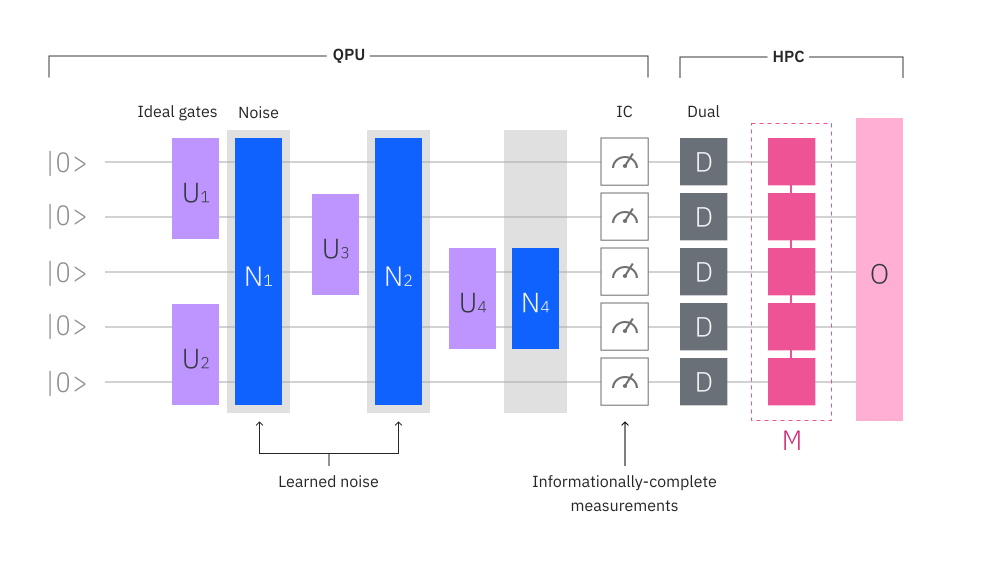
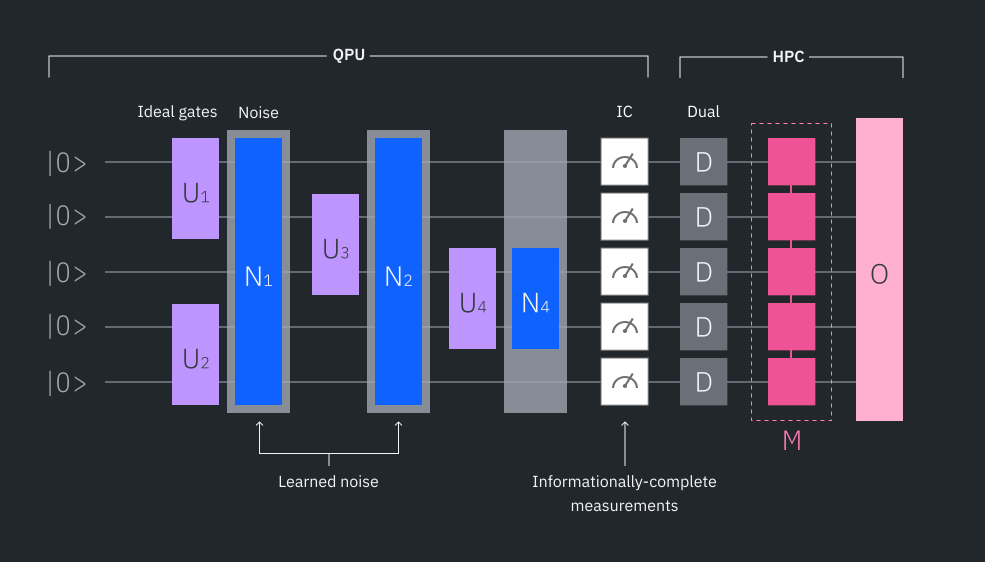
Once the circuits are submitted to the function, they are transpiled and optimized to minimize the number of layers with two-qubit gates (the noisier gates on quantum devices). The noise affecting the layers is learned through Qiskit Runtime using a sparse Pauli-Lindblad noise model as described in E. van den Berg, Z. Minev, A. Kandala, K. Temme, Nat. Phys. (2023). arXiv:2201.09866.
The noise model is an accurate description of the noise on the device able to capture subtle features, including qubit cross-talk. However, noise on the devices can fluctuate and drift and the learned noise might not be accurate at the point at which the estimation is done. This might result in inaccurate results.
Get started
Authenticate using your IBM Quantum Platform API key, and select the TEM function as follows. (This snippet assumes you've already saved your account to your local environment.)
from qiskit_ibm_catalog import QiskitFunctionsCatalog

tem_function_name = "algorithmiq/tem"
catalog = QiskitFunctionsCatalog(channel="ibm_quantum_platform")
# verify that you have access to the function
catalog.list()
Output:
[QiskitFunction(qunova/hivqe-chemistry),
 QiskitFunction(global-data-quantum/quantum-portfolio-optimizer),
 QiskitFunction(algorithmiq/tem),
 QiskitFunction(qedma/qesem),
 QiskitFunction(multiverse/singularity),
 QiskitFunction(ibm/circuit-function),
 QiskitFunction(q-ctrl/optimization-solver),
 QiskitFunction(colibritd/quick-pde),
 QiskitFunction(q-ctrl/performance-management),
 QiskitFunction(kipu-quantum/iskay-quantum-optimizer)]
# Load your function
tem = catalog.load(tem_function_name)
Example
The following snippet shows an example where TEM is used to compute the expectation values of an observable given a simple quantum circuit.
from qiskit import QuantumCircuit
from qiskit.quantum_info import SparsePauliOp

# Create a quantum circuit
qc = QuantumCircuit(3)
qc.u(0.4, 0.9, -0.3, 0)
qc.u(-0.4, 0.2, 1.3, 1)
qc.u(-1.2, -1.2, 0.3, 2)
for _ in range(2):
    qc.barrier()
    qc.cx(0, 1)
    qc.cx(2, 1)
    qc.barrier()
    qc.u(0.4, 0.9, -0.3, 0)
    qc.u(-0.4, 0.2, 1.3, 1)
    qc.u(-1.2, -1.2, 0.3, 2)

# Define the observables
observable = SparsePauliOp("IYX", 1.0)

# Define the execution options
pub = (qc, [observable])
options = {"default_precision": 0.02}

# Define backend to use. TEM will choose the least-busy device
# reported by IBM if not specified
backend_name = "ibm_marrakesh"

# Run the TEM function (uses around three minutes of QPU time)
job = tem.run(pubs=[pub], backend_name=backend_name, options=options)
Use the Qiskit Serverless APIs to check your Qiskit Function workload's status:
# Print the ID so you can use it later, if necessary
print(job.job_id)
print(job.status())
Output:
ea1d7802-b067-4cc9-af39-3c2402d22413
QUEUED
You can return the results as:
result = job.result()
evs = result[0].data.evs
print(evs[0])
Output:
-0.10628832892063486
The expected value for the noiseless circuit for the given operator should be around 0.18409094298943401.
Get support
Reach out to qiskit_ibm@algorithmiq.fi
Be sure to include the following information:
- Qiskit Function Job ID (
qiskit-ibm-catalog),job.job_id - A detailed description of the issue
- Any relevant error messages or codes
- Steps to reproduce the issue
Next steps
- Request access to Algorithmiq Tensor-network error mitigation.
- Visit the API reference for this Qiskit Function.