Get started with Orbit by Quantum Elements
See the overview and the API reference
IBM Quantum® Functions are a beta feature available only to IBM Quantum Premium Plan, Flex Plan, and On-Prem (through the IBM Quantum Platform API) Plan users. Beta features are subject to change.
Set up and load the function
Authenticate using your IBM Quantum Platform API key, and select the Orbit function as follows. This snippet assumes you've already saved your account to your local environment.
from qiskit_ibm_catalog import FunctionsCatalog
from qiskit import QuantumCircuit

catalog = FunctionsCatalog(channel="ibm_quantum_platform")
# Verify that you have access to the function.
catalog.list()
Output:
[QiskitFunction(quantum-elements/orbit-dev),
 QiskitFunction(quantum-elements/orbit)]
# Load the function.
orbit = catalog.load("quantum-elements/orbit")
print("Orbit version:", orbit.version)
Output:
Orbit version: 0.3.23
Function sizes
Every job runs at one size — S, M, or L. If the specified size is too small, the job is rejected. If it is larger
than needed, it runs on a bigger compute profile than the work requires. See the managed workflow documentation for how sizes work in general.
The size comes from your circuit after it is mapped onto the backend you target: the number of qubits that carry an operation, and the two-qubit-gate depth. Mapping can add both, so a circuit is sized as it will run, not as you wrote it.
Size | Smallest size for active qubits and two-qubit-gate depth | Compute profile | vCPU | RAM |
|---|---|---|---|---|
S | both at most 40 | 8x32 | 8 | 32 GB |
M | both at most 100 | 16x128 | 16 | 128 GB |
L | either above 100 | 48x768 | 48 | 768 GB |
A circuit must fit both bounds of a size, so 30 qubits at a two-qubit-gate depth of
120 is L, not S. These are the same bounds for every circuit function, so a size
means the same difficulty of circuit whichever one you call.
The default is M, used when a job does not request a size.
Users can also read the mapping off the function itself with function.sizes_map, and
the size used when a job does not ask for one with function.default_size.
Orbit checks the size against the backend the job runs on. If you omit backend_name,
Orbit picks the least busy backend, so pass backend_name explicitly when you size a job
in advance.
Each circuit is measured twice: as you submit it, and as a copy with its delays removed,
laid out with Sabre and routed. The job is checked against the smaller of the two sizes.
So a circuit you have already scheduled (for example with scheduling_method="alap"),
which carries a delay on every idle qubit of the device, is sized by the qubits it uses
rather than by the width of the device, and a chain of qubits is not sized by SWAPs that a
better layout avoids. The calculator below runs the same calculation as Orbit, so it
returns the size your job is checked against.
Calculate the size before submitting
Run this on your own circuits. It reads them and does nothing else; no job is submitted and nothing is reserved, so you can call it as often as you like while you tune a circuit down to a smaller size.
It needs the backend as well as the circuits, because the size depends on the coupling map they are mapped onto. It requires only Qiskit.
# Calculate the function size a circuit needs, before submitting it.
#
# Call ``calculate_function_size(pubs, backend)``: it returns "S", "M" or "L" and submits
# nothing. Pass the whole list of PUBs. A job runs at one size, and the heaviest PUB
# determines the size. The circuit is measured after being mapped onto the ``backend``, since mapping
# can add both qubits and depth.
#
# This is the calculation Orbit runs on every job. Each circuit is measured twice, as given
# and as a copy with its delays removed, laid out with Sabre and routed, and is sized as
# the smaller of the two. The copy keeps a scheduled circuit from being sized by the idle
# qubits its delays cover, and a chain from picking up SWAPs a better layout avoids.

from collections.abc import Iterable
from typing import Any, Literal

from qiskit.circuit import Barrier, Delay
from qiskit.circuit.equivalence_library import SessionEquivalenceLibrary
from qiskit.transpiler import PassManager, generate_preset_pass_manager
from qiskit.transpiler.passes import (
    ApplyLayout,
    BarrierBeforeFinalMeasurements,
    BasisTranslator,
    EnlargeWithAncilla,
    FilterOpNodes,
    FullAncillaAllocation,
    HighLevelSynthesis,
    SabreSwap,
    TrivialLayout,
    UnitarySynthesis,
)

Size = Literal["S", "M", "L"]
_ORDER = {"S": 0, "M": 1, "L": 2}

# Limits are provided by IBM
_SMALL_QUBITS, _SMALL_DEPTH_2Q = 40, 40
_MEDIUM_QUBITS, _MEDIUM_DEPTH_2Q = 100, 100

# Any fixed value works; what matters is that it does not change between calls.
_SEED_TRANSPILER = 42

# Added by BarrierBeforeFinalMeasurements so routing cannot move gates past a measurement,
# then removed again once routing is done.
_PROTECTION_BARRIER = "qiskit.transpiler.internal.routing.protection.barrier"


def calculate_function_size(
    circuit: QuantumCircuit | Iterable[Any], backend, **kwargs: Any
) -> Size:
    """Return the size ("S", "M" or "L") required to run the function."""
    circuits = pub_circuits(circuit)
    if not circuits:
        raise ValueError(
            "No circuit to size: pass a QuantumCircuit or a non-empty list of PUBs."
        )
    prepare = generate_preset_pass_manager(
        optimization_level=0,
        target=backend.target,
        layout_method="sabre",
        seed_transpiler=_SEED_TRANSPILER,
    )
    return max(
        (_smaller_size(qc, backend, prepare, **kwargs) for qc in circuits),
        key=_ORDER.__getitem__,
    )


def _smaller_size(
    circuit: QuantumCircuit, backend, prepare: PassManager, **kwargs: Any
) -> Size:
    """Return the smaller size of ``circuit`` and of its copy without delays, laid out with Sabre.

    Level 0 runs no optimization stage, so the copy keeps every gate of the circuit.
    """
    size = _calculate_circuit_size(circuit, backend, **kwargs)
    if size == "S":
        return size
    prepared = prepare.run(without_delays(circuit))
    return min(
        size,
        _calculate_circuit_size(prepared, backend, **kwargs),
        key=_ORDER.__getitem__,
    )


def without_delays(circuit: QuantumCircuit) -> QuantumCircuit:
    """Return a copy of ``circuit`` with every top-level ``delay`` removed."""
    stripped = circuit.copy_empty_like()
    for instruction in circuit.data:
        if not isinstance(instruction.operation, Delay):
            stripped.append(instruction)
    return stripped


def _calculate_circuit_size(
    circuit: QuantumCircuit, backend, **kwargs: Any
) -> Size:
    """Return the size required to run a single circuit."""
    metrics = _measure(circuit, backend, **kwargs)
    if _is_small(metrics):
        return "S"
    if _is_medium(metrics):
        return "M"
    return "L"


def pub_circuits(problem: Any) -> list[QuantumCircuit]:
    """Return the circuits in ``problem``: one circuit, or one per PUB in a list."""
    if isinstance(problem, QuantumCircuit):
        return [problem]
    circuits: list[QuantumCircuit] = []
    for index, pub in enumerate(problem):
        if isinstance(pub, QuantumCircuit):
            circuit = pub
        elif isinstance(getattr(pub, "circuit", None), QuantumCircuit):
            circuit = pub.circuit
        elif (
            isinstance(pub, (tuple, list))
            and pub
            and isinstance(pub[0], QuantumCircuit)
        ):
            circuit = pub[0]
        else:
            raise ValueError(f"PUB #{index} has no QuantumCircuit to size.")
        circuits.append(circuit)
    return circuits


def _pass_manager(target) -> PassManager:
    """Return the pass manager used to map a circuit onto ``target``.

    Fixed and seeded, so the same circuit always gives the same size.
    """
    basis = list(target.operation_names)
    library = SessionEquivalenceLibrary
    return PassManager(
        [
            UnitarySynthesis(
                basis, approximation_degree=1.0, min_qubits=3, target=target
            ),
            HighLevelSynthesis(
                target=target,
                equivalence_library=library,
                basis_gates=basis,
                min_qubits=3,
            ),
            BasisTranslator(library, basis, target=target, min_qubits=3),
            TrivialLayout(target),
            FullAncillaAllocation(target),
            EnlargeWithAncilla(),
            ApplyLayout(),
            BarrierBeforeFinalMeasurements(label=_PROTECTION_BARRIER),
            SabreSwap(
                target, heuristic="basic", seed=_SEED_TRANSPILER, trials=5
            ),
            FilterOpNodes(lambda node: node.label != _PROTECTION_BARRIER),
            UnitarySynthesis(basis, approximation_degree=1.0, target=target),
            HighLevelSynthesis(
                target=target,
                equivalence_library=library,
                basis_gates=basis,
                use_qubit_indices=True,
            ),
            BasisTranslator(library, basis, target=target),
        ]
    )


def _count(isa: QuantumCircuit) -> dict:
    """Return the active qubits and two-qubit-gate depth of a mapped circuit."""
    active = {
        q
        for instr in isa.data
        if not isinstance(instr.operation, Barrier)
        for q in instr.qubits
    }
    return {
        "num_qubits": len(active),
        "depth_2q": isa.depth(
            filter_function=lambda instr: len(instr.qubits) == 2
            and not isinstance(instr.operation, Barrier)
        ),
    }


def _measure(circuit: QuantumCircuit, backend, **kwargs: Any) -> dict:
    """Map ``circuit`` onto ``backend`` and return its metrics."""
    return _count(_pass_manager(backend.target).run(circuit))


def _is_small(metrics: dict) -> bool:
    """Determine if the metrics fit T-size 'S'."""
    return (
        metrics["num_qubits"] <= _SMALL_QUBITS
        and metrics["depth_2q"] <= _SMALL_DEPTH_2Q
    )


def _is_medium(metrics: dict) -> bool:
    """Determine if the metrics fit T-size 'M'."""
    return (
        metrics["num_qubits"] <= _MEDIUM_QUBITS
        and metrics["depth_2q"] <= _MEDIUM_DEPTH_2Q
    )
Pass the whole list of PUBs, not one at a time. A job runs at a single size, so
the heaviest PUB determines the size. One deep circuit among many shallow ones makes the
whole job L. Split the batch into separate jobs to keep the cheap ones
cheap. The example below calculates the size of its PUBs and passes it to
orbit.run as function_size.
If the size is too small the job fails with error 4600 and the message names the
size to use instead. If it is larger than needed, the job runs normally and records a
4601 advisory event. See the managed workflow documentation to learn more.
Example
The following example builds a Bernstein-Vazirani circuit and submits it to Orbit two ways in one job: raw execution and Orbit defaults.
Use this pattern when you want a direct raw-versus-Orbit comparison.
Scaling Bernstein-Vazirani to larger sizes
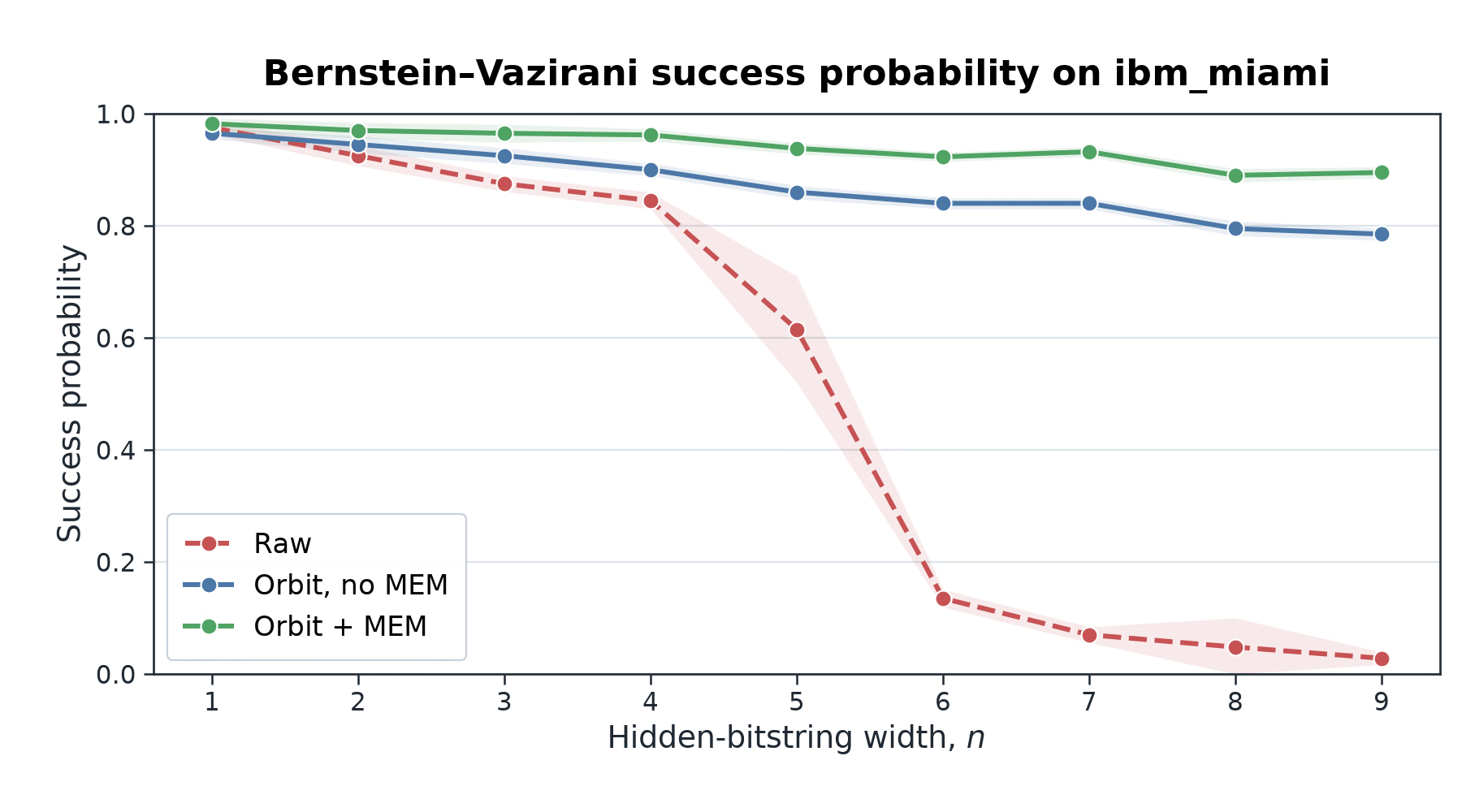
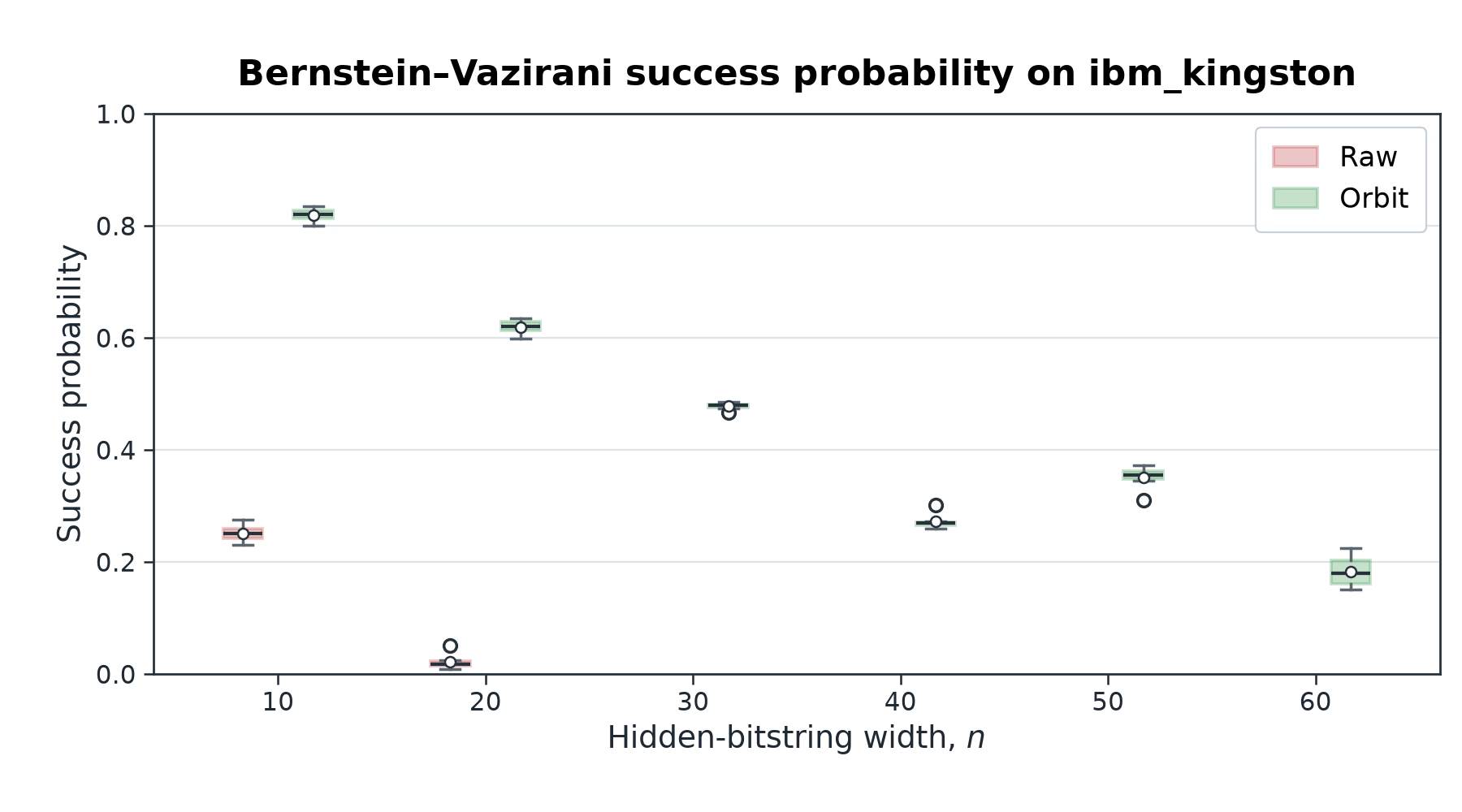
Orbit can help preserve Bernstein-Vazirani success probability as the hidden-bitstring width grows. The representative scaling runs below compare raw execution with Orbit configurations on IBM Quantum hardware. On ibm_miami, raw success probability falls below 10% by a hidden-bitstring width of 9 (10 total qubits), while Orbit remains near 80–90%. On ibm_kingston, Orbit maintains non-trivial success probability at widths approaching 60, including approximately 15% at the largest size shown. Exact results depend on the backend calibration, circuit, and execution settings.
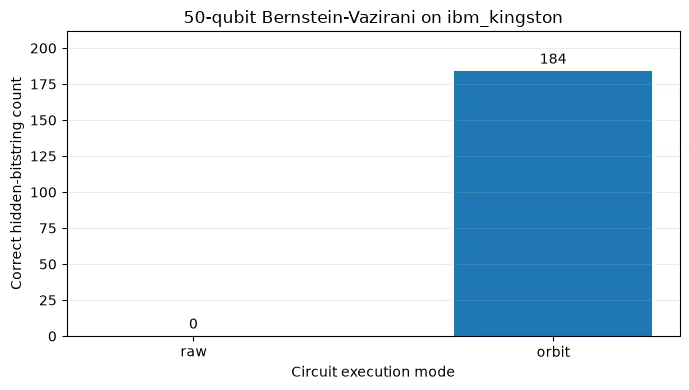
To preserve QPU time, this tutorial does not rerun a size sweep. Instead, the executable example below reports shot counts for one fixed hidden-bitstring width, N = 50 (51 total qubits in this circuit), comparing raw execution with Orbit defaults in a single job.
Build a Bernstein-Vazirani circuit
Choose the hidden bitstring and construct the logical circuit. The extra qubit is the oracle target, while the input qubits are measured.
def create_bv_circuit(hidden_bitstring: str) -> QuantumCircuit:
    width = len(hidden_bitstring)
    circuit = QuantumCircuit(width + 1, width)

    circuit.x(width)
    circuit.h(range(width + 1))

    for input_qubit, bit in enumerate(reversed(hidden_bitstring)):
        if bit == "1":
            circuit.cx(input_qubit, width)

    circuit.barrier()
    circuit.h(range(width + 1))
    circuit.measure(range(width), range(width))
    return circuit


circuit_width = 50
hidden_bitstring = "1" * circuit_width
shots = 4096

bv_circuit = create_bv_circuit(hidden_bitstring)
bv_circuit.count_ops()
Output:
OrderedDict([('h', 102),
             ('cx', 50),
             ('measure', 50),
             ('x', 1),
             ('barrier', 1)])
Prepare the Orbit workload
Create one Sampler PUB, then duplicate it for the two comparison modes. Orbit receives the logical circuit and maps it to the selected backend during execution.
base_pub = (bv_circuit, None, shots)
comparison_labels = ["raw", "orbit"]
pubs = [base_pub] * len(comparison_labels)
Calculate the function size
Calculate the size of the PUBs on the backend you run on. The 50-qubit circuit needs
routing on the heavy-hex coupling map, which takes its two-qubit gate depth above 100,
so this job needs L.
from qiskit_ibm_runtime import QiskitRuntimeService

backend_name = "ibm_kingston"
backend = QiskitRuntimeService().backend(backend_name)

size = calculate_function_size(pubs, backend)  # "S", "M" or "L"
print(size)
Output:
L
Run raw and Orbit defaults
pub_options assigns the first PUB to raw mode, which skips Orbit optimization, DD, and MEM, and assigns the second PUB to Orbit defaults, which include optimized transpilation, automated dynamical decoupling (DD) insertion, and measurement error mitigation (MEM).
The job runs at the size calculated above. Without function_size, it would run at M, which is too small for these PUBs, so it would fail with error 4600.
job = orbit.run(
    primitive="sampler",
    pubs=pubs,
    backend_name=backend_name,
    function_size=size,
    options={
        "pub_options": [
            {"mode": "raw"},
            {"mode": "orbit"},
        ],
        "save_backend_info": True,
    },
)

# Check the job ID and status
print(job.job_id)
print(job.status())
Output:
2c427a80-4190-404c-b98a-6bbeb53fafcd
QUEUED
Retrieve the result and compare the raw and Orbit-enhanced circuits using counts. For Sampler results, get_counts() on the returned classical register provides the output histogram. When MEM succeeds for the Orbit PUB, this histogram is already MEM-corrected; the unmitigated counts remain available in the Orbit metadata under measurementErrorMitigation["rawCounts"].
def extract_counts(pub_result) -> dict[str, int]:
    data = getattr(pub_result, "data", None)
    if data is None:
        raise TypeError("pub_result.data is missing")

    for name in dir(data):
        if name.startswith("_"):
            continue
        register = getattr(data, name)
        get_counts = getattr(register, "get_counts", None)
        if callable(get_counts):
            counts = get_counts()
            if counts:
                return counts

    raise TypeError(
        "No classical register with get_counts() found in pub_result.data"
    )


result = job.result()
if len(result) != len(comparison_labels):
    raise RuntimeError(
        f"Expected {len(comparison_labels)} PUB results, received {len(result)}."
    )

comparison_counts = {
    label: extract_counts(pub_result)
    for label, pub_result in zip(comparison_labels, result, strict=True)
}
correct_counts = {
    label: counts.get(hidden_bitstring, 0)
    for label, counts in comparison_counts.items()
}

print(
    {
        "hidden_bitstring": hidden_bitstring,
        "correct_counts": correct_counts,
        "shots": shots,
    }
)
Output:
{'hidden_bitstring': '11111111111111111111111111111111111111111111111111', 'correct_counts': {'raw': 0, 'orbit': 370}, 'shots': 4096}
Make a visual comparison of the raw and Orbit-enhanced circuits.
import matplotlib.pyplot as plt

labels = list(correct_counts)
values = list(correct_counts.values())
fig, ax = plt.subplots(figsize=(7, 4))
bars = ax.bar(labels, values, width=0.55)
ax.bar_label(bars, labels=[f"{value:g}" for value in values], padding=3)
ax.set_xlabel("Circuit execution mode")
ax.set_ylabel("Correct hidden-bitstring count")
ax.set_title(f"{circuit_width}-qubit Bernstein-Vazirani on {backend_name}")
ax.set_ylim(0, max(1, 1.15 * max(values)))
ax.grid(axis="y", alpha=0.25)
fig.tight_layout()
plt.show()
Output:
Next steps
- Try a different backend, qubit number, or another hidden bitstring.
- Try the quantum Fourier transform tutorial to learn how to define orbit-enabled custom DD strategies and apply DD to dynamic circuits with mid-circuit measurements and feedforward operations.
- Visit the API reference for a detailed description of all Orbit options.
- Learn how to choose a problem size.